On March 28, the world-renowned academic journal Nature published a collaborative study led by Prof. Bing Li, Prof. Zhidong Zhang, and Prof. Weijun Ren from the Institute of Metal Research, Chinese Academy of Sciences (IMR, CAS), together with researchers from Japan, the United States, and Australia. The team discovered a colossal barocaloric effect in plastic crystal materials, which can serve as a new type of solid-state cooling material and has great potential to significantly improve cooling efficiency.
According to United Nations statistics, 25–30% of global electricity consumption each year is used for various cooling applications, most of which rely on traditional gas-compression refrigeration technologies employing refrigerants that are harmful to the environment and human health. Therefore, developing green, environmentally friendly, and energy-efficient cooling alternatives has become a shared goal of academia and industry. In particular, since China’s high-end compressor technologies still lag behind those of leading countries, exploring new solid-state cooling methods could fundamentally address this technological bottleneck.
The performance of solid-state phase-transition cooling materials is mainly characterized by their isothermal entropy change. After decades of research, mainstream solid-state phase-transition cooling materials have achieved isothermal entropy changes of around 50 J·kg⁻¹·K⁻¹, but only under large external fields, which presents a challenge to practical applications.
Researchers at IMR selected a plastic crystal known as neopentyl glycol (NPG) and employed high-pressure calorimetry, neutron scattering, and synchrotron X-ray diffraction techniques. Their measurements revealed a maximum isothermal entropy change of up to 389 J·kg⁻¹·K⁻¹, which is an order of magnitude greater than that of conventional solid-state phase-transition cooling materials (see Figure below).
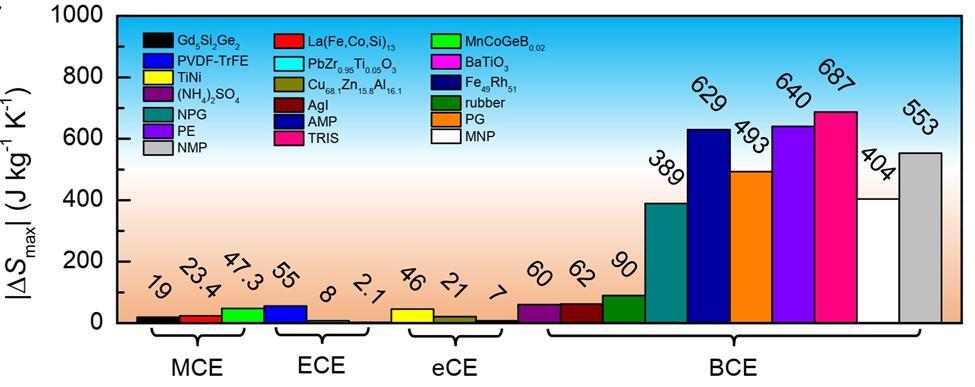
Comparison of the Maximum Isothermal Entropy Change between the Reported Plastic Crystal and Conventional Solid-State Cooling Materials
The study further uncovered the underlying physical mechanism behind the barocaloric effect in plastic crystals: due to the high orientational disorder of molecular arrangements in the plastic phase, even a modest applied pressure can induce substantial structural rearrangements, resulting in a large entropy change.
Prof. Bing Li noted that plastic crystal materials require low driving pressures and are cost-effective, making them promising candidates for next-generation cooling technologies. Incorporating plastic crystals into the study of solid-state phase-transition refrigeration materials broadens the material landscape and offers new possibilities for discovering and designing more efficient cooling materials.
(Reported by the Liaoning Bureau of China Daily)
Editor: Huang Heliu
The above is a translated version of the related report published by China Daily on March 28, 2019.