From the United States to Japan and then back to China — from magnetic caloric to barocaloric cooling, from zero-carbon refrigeration to controllable heat storage — Prof. Bing Li, a researcher of the post-1980s generation at the Institute of Metal Research (IMR), Chinese Academy of Sciences (CAS), has been dedicated to developing energy-efficient and environmentally friendly materials for cooling and thermal storage.
Recently, the 17th China Youth Science and Technology Award was announced, and Bing Li was among the 100 recipients. The award recognizes outstanding young scientists who have made significant contributions to the nation’s economic development, social progress, and scientific innovation. Candidates must be under 40 years old, and the award is presented biennially.
In an interview with China Science Daily, Li said, “It’s not easy to receive such an honor. Our work has made meaningful progress toward China’s ‘carbon peaking and carbon neutrality’ goals by successfully integrating cooling and heat-storage materials.”
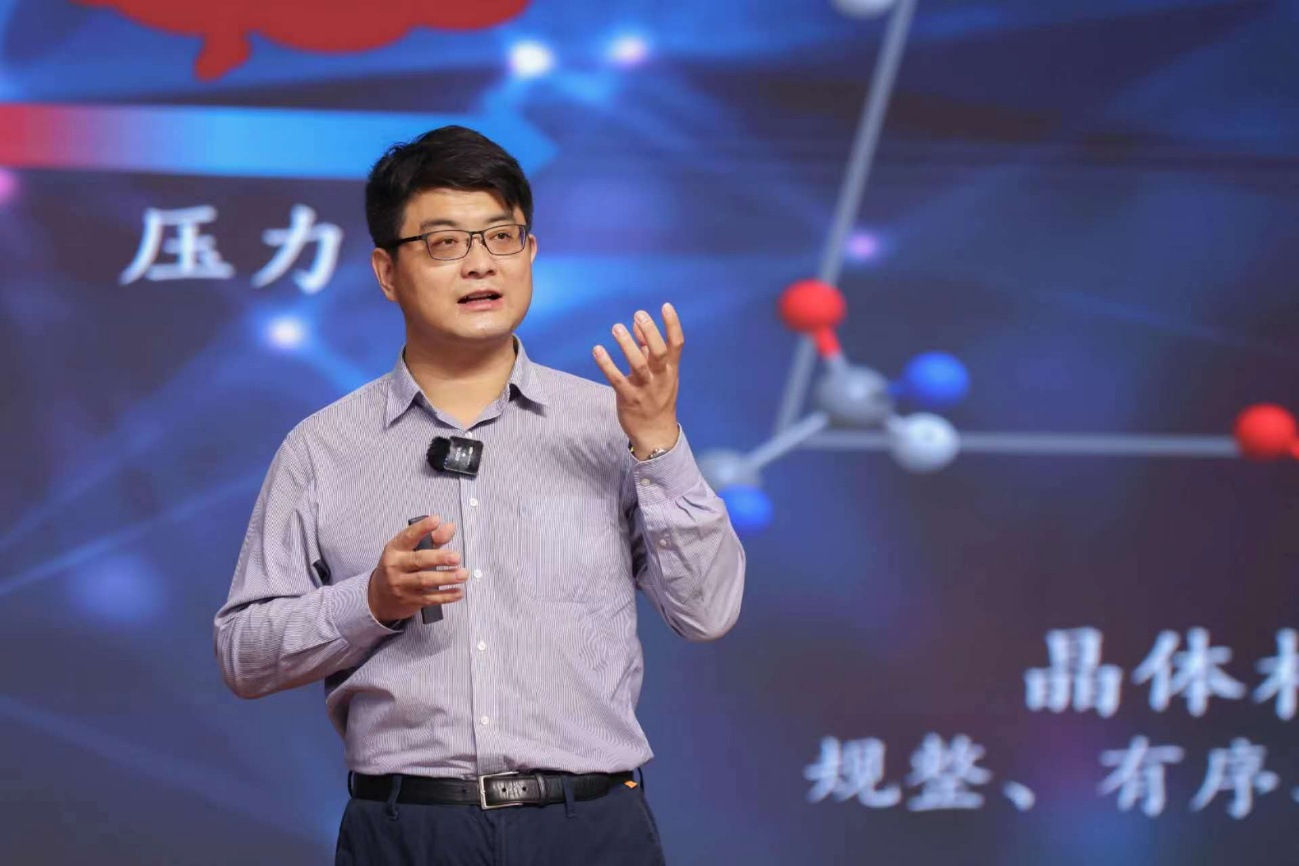
Image courtesy of Bing Li
A Fortunate Shift in Research Direction
Bing Li earned his Ph.D. from IMR in 2012, where his research focused on magnetocaloric refrigeration—a technology that exploits the magnetocaloric effect of magnetic materials to achieve cooling. The magnetocaloric effect refers to a material’s absorption or release of heat when the arrangement of its magnetic moments changes under a varying magnetic field.
After completing his Ph.D., Li pursued postdoctoral research in the Department of Physics at the University of Virginia, USA. “My advisor was then the president of the American Neutron Scattering Society,” he recalled. “Under her guidance, I had access to the Spallation Neutron Source at Oak Ridge National Laboratory, where I began applying high-pressure neutron scattering and synchrotron X-ray scattering techniques to study crystalline materials — a highly cutting-edge area.”
Li described his transition from magnetocaloric to barocaloric research as “a fortunate coincidence.” His experience abroad opened new perspectives on disordered crystalline materials, an area he had previously explored.
Between 2015 and early 2018, Li worked at the Japan Proton Accelerator Research Complex (J-PARC) as a member of the neutron spectroscopy group, focusing on inelastic neutron scattering studies of functional materials exhibiting structural disorder.
Upon returning to China in 2018, Li joined IMR and established the Neutron Scattering Research Group at the Shenyang National Laboratory for Materials Science, focusing on atomic, molecular, and magnetic disorder in materials. It was during this period that he made a serendipitous discovery.“We discovered an entirely new class of materials,” Li said. “They can not only achieve zero-carbon cooling and eliminate environmental hazards associated with conventional refrigeration, but also enable the collection and reuse of waste heat—reducing carbon emissions and improving energy efficiency.”
So, what kind of material can both cool and store heat?
Promising Progress in Barocaloric Cooling Technology
According to United Nations statistics, 25–30% of global electricity consumption is devoted to various cooling applications, which play an indispensable role in both industrial production and daily life.
Li noted that China still lacks advanced compressor technology for high-end cooling systems. Thus, exploring alternative cooling mechanisms offers a potential solution to this “bottleneck” problem.
In recent years, both academia and industry have been striving to develop green, environmentally friendly, and low-energy alternatives to traditional cooling technologies.
Research has shown that the solid-solid phase change in materials (a phase transition refers to the transformation between different states of matter, such as solid, liquid, and gas), is often accompanied by a significant absorption or release of heat. Consequently, solid-solid phase-change-based cooling is considered one of the most promising alternatives to gas-compression refrigeration.
However, the cooling performance of such solid-solid phase change materials still falls far short of liquid refrigerants, posing a major obstacle to practical applications.
Inspired by neutron scattering studies, Li began searching for new solid materials to overcome this limitation. His team conducted in-depth research on enhancing the performance of solid-solid phase-change cooling materials and eventually discovered a plastic crystal with exceptional properties.
“Through neutron scattering, we observed that molecules in plastic crystals rotate randomly and remain in a high-energy state,” Li explained. “Because these materials are very soft, applying even a small pressure suppresses the molecular motion, lowering the energy state and releasing a large amount of heat.”
Li named this pressure-induced phase-transition cooling phenomenon the colossal barocaloric effect. The aforementioned plastic crystal materials exhibit the colossal barocaloric effect, in which pressure induces a phase transition that produces a cooling effect. The related findings were published in Nature in 2019.
Using plastic crystals as the working medium, Prof. Bing Li and his team developed the first prototype of a barocaloric cooling device. “Plastic crystals require only a small driving pressure and are low in cost, making them promising candidates for novel cooling materials,” Li said. “Our research provides a new approach for the development of next-generation solid-state refrigeration technology and has the potential to significantly improve cooling efficiency.”
In recognition of this achievement, Li was awarded the 2019 Society Award by the Japan Society for Neutron Science, becoming the first non-Japanese scientist to receive the award.
Changing Perspectives and Dimensions
In recent years, while advancing solid-state cooling research, Li has also been contemplating how to efficiently recover and reuse waste heat.
According to the International Energy Agency, approximately 31% of primary energy is consumed for heat production, while another 28% is wasted as heat during energy conversion processes. Heat production, in turn, accounts for around 30% of global carbon emissions.
“Although thermal energy is abundant, utilization of it by human remains very limited,” Li explained. “This is mainly due to low collection efficiency, poor transportability, and the difficulty of regulating temperature and storage duration. If we could recover and reuse waste heat, we would not only reduce energy consumption but also lower carbon emissions.”
Li once again turned his attention to plastic crystals. Through experiments, his team found that certain plastic crystal materials store heat near 80 °C by transitioning into a plastic crystalline phase. When cooled to room temperature, applying a small pressure of about 6 MPa—roughly equivalent to the force of a human hand squeeze—induces a rapid transition back to the ordered crystalline phase, releasing the stored heat and raising the temperature by up to 50 °C within 20 seconds.
Li summarized this unique property as: “Heat absorption upon heating, heat locking upon cooling, and heat release upon compression.”
Building upon these findings, his team designed a barocaloric thermal battery. Li revealed that this system enables low-grade waste-heat recovery, long-term storage, long-distance transport, and controllable reuse, achieving an overall energy efficiency of 92%. The corresponding results are forthcoming in Science Advances.
Although heating and cooling are typically considered opposites, Li’s research has broken this dichotomy, opening a new dimension of thermal control. “The key,” he said, “lies in changing our perspective and research dimension.”
Over the past three years, due to experimental constraints, Li has had to send samples to international collaborators for neutron scattering measurements. He hopes that the second phase of China’s Spallation Neutron Source will be completed soon—so that such experiments can finally be conducted domestically.
The above is a translated version of the related report published by China Science Daily on February 4, 2023.