Researchers from the Institute of Metal Research, Chinese Academy of Sciences (IMR, CAS) have developed an innovative polymer material that integrates ion conduction and storage functions at the molecular level, offering new solutions to one of the most interface challenges in solid-state batteries.
These findings, published in Advanced Materials under the title "Potential-gated polymer integrates reversible ion transport and storage for solid-state batteries”, introduces a material that could fundamentally redesign the core architecture of batteries.
Solid-state batteries are widely being considered as the future of energy storage, promising superior safety and high energy density. However, conventional designs separate ion conduction and storage functions between electrolyte and electrode materials, leading to high interface resistance and discontinuous ion transport.
To overcome this, the research team created a novel polymer, P(EO₂-S₃). Its backbone covalently combines ion-conducting ethoxy groups with redox-active short sulfur chains. This molecular design enables the material to simultaneously function as ion conductor and energy storage unit, achieving an ionic conductivity of 1.0 × 10⁻⁴ S cm⁻¹ at 50°C and a specific capacity of 491.7 mAh g⁻¹.
"Unlike conventional interfaces where two different materials meet, our approach creates molecular-scale integration within a single material," explained the research team. "The electronic structure of P(EO₂-S₃) can reversibly transform with potential, allowing controlled switching between ion transport and storage behaviors."
The potential-gated characteristic enables diverse applications. When used as a polymer electrolyte with conventional cathodes like lithium iron phosphate, its redox activity can be activated at specific potentials, boosting the cathode's energy density by 86%. Flexible batteries constructed with P(EO₂-S₃) demonstrated exceptional durability, withstanding over 20,000 bending cycles while maintaining fast electrochemical reaction kinetics.
This work provides not only a deeper fundamental understanding of ion transport and storage mechanisms in polymers but also a new design paradigm for high-performance integrated electrode-electrolyte materials, potentially accelerating the commercialization of next-generation solid-state batteries.
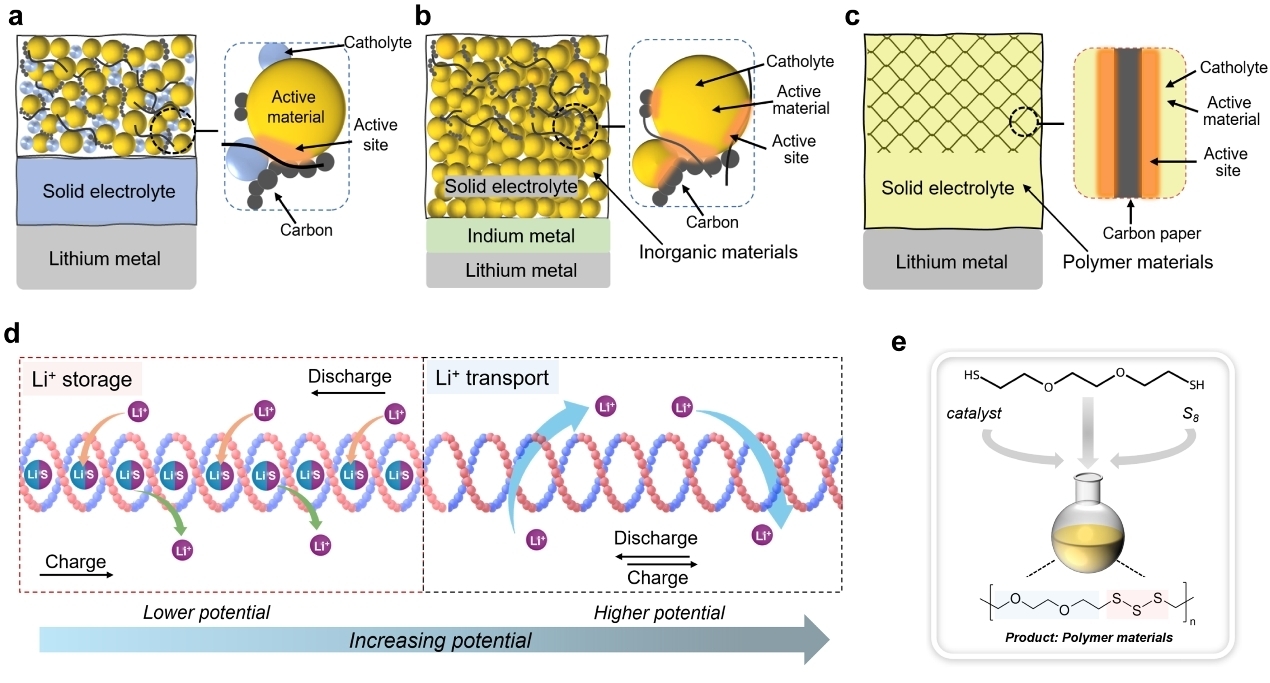
Design of the integrated polymer electrode-electrolyte material. (Image by IMR)
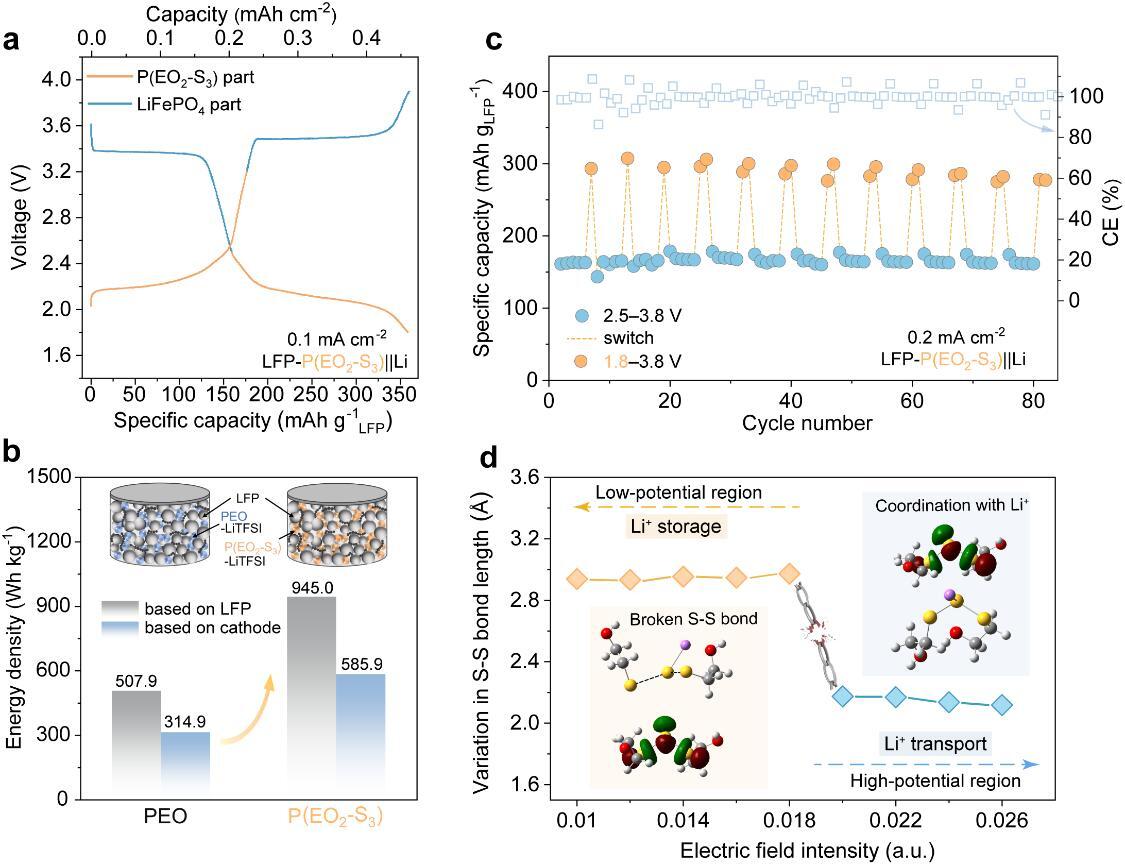
Electrochemical performance of the integrated polymer and its potential-dependent ion transport-storage mechanism. (Image by IMR)