Researchers from the Institute of Metal Research, Chinese Academy of Sciences (IMR, CAS) have discovered a breakthrough ferromagnetic material, NH₄GdF₄, that could revolutionize compact ultralow-temperature refrigeration systems operating at temperatures below 1 Kelvin-a critical need for quantum computing and space exploration.
The study, published in J. Am. Chem. Soc., identified that NH₄GdF₄ exhibits exceptional magnetocaloric performance at temperatures below 1 Kelvin, significantly outperforming conventional paramagnetic materials currently used in adiabatic demagnetization refrigerators.
Current materials like gadolinium gallium garnet (GGG) have been widely employed in ultralow-temperature cooling, but limited by their antiferromagnetic nature, which requires strong magnetic fields typically generated by bulky superconducting magnets. This has hindered the development of compact and energy-efficient cryogenic systems.
The research team's new material overcomes this bottleneck through itsunique ferromagnetic characteristics. NH₄GdF₄ undergoes a ferromagnetic transition at 0.85 K and demonstrates remarkably high magnetic entropy changes - reaching 51.6 J·kg⁻¹·K⁻¹ under 20 kOe field, approximately 2.5 times greater than GGG. More importantly, it achieves superior performance even at lower fields, with 38.2 J·kg⁻¹·K⁻¹ under just 10 kOe, a nine-fold improvement over conventional materials.
"Ferromagnetic materials represent a promising pathway for compact magnetic refrigeration," the research team stated. "NH₄GdF₄'s ability to cool from liquid helium temperature down to 0.79 K using moderate magnetic fields makes it particularly attractive for real-world applications."
The material's low magnetic anisotropy allows easy magnetization saturation under small fields, enabling more efficient cooling cycles. Starting from 4 K, adiabatic demagnetization of NH₄GdF₄ reaches temperatures as low as 0.79 K, significantly outperforming GGG, which stops at the 1.5 K under similar conditions.
This breakthrough not only offers a superior replacement for current refrigerants but also validates a ferromagnetic approach to ultralow-temperature cooling, potentially leading to more samller, lighter and efficient refrigeration systems in advanced technological applications.
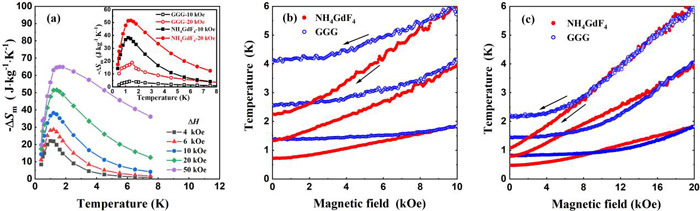
Ultralow-temperature magnetocaloric performance of NH₄GdF₄ (Image by IMR)