Researchers from the Institute of Metal Research, Chinese Academy of Sciences (IMR, CAS), have made a series of advances in controlling the properties of lead-free ferroelectric materials, achieving new levels of precision in manipulating atomic-scale structures known as domain walls.
Ferroelectric domain walls, which separate regions with different polarization orientations, play a critical role in determining material properties. By controlling the behavior of these walls, especially those that are electrically charged, researchers can create novel functional interfaces with tailored magnetic and electronic characteristics.
The research team, led by Prof. TANG Yunlong in collaboration with Prof. MA Xiuliang and Prof. ZHU Yinlian, has published three key studies in leading journals. Their work demonstrates precise control over charged domain walls and introduces new approaches to creating multifunctional lead-free materials.
In the series of studies, the team successfully constructed millimeter-scale in-plane charged domain walls in Na₀.₅Bi₀.₅TiO₃ thin films using thermodynamic and asymmetric interface control methods and showed how to manipulate periodic charged domain wall arrays in BiFeO₃ films by designing electrical boundary conditions. Furthermore, researchers developed a novel SmMnO₃:NiO composite film that combines room-temperature ferroelectricity with high-temperature ferromagnetism, demonstrating potential for multifunctional applications.
The findings provide important insights into the stability of charged domain walls and their potential for device integration, contributing to the development of environmentally friendly electronic materials.
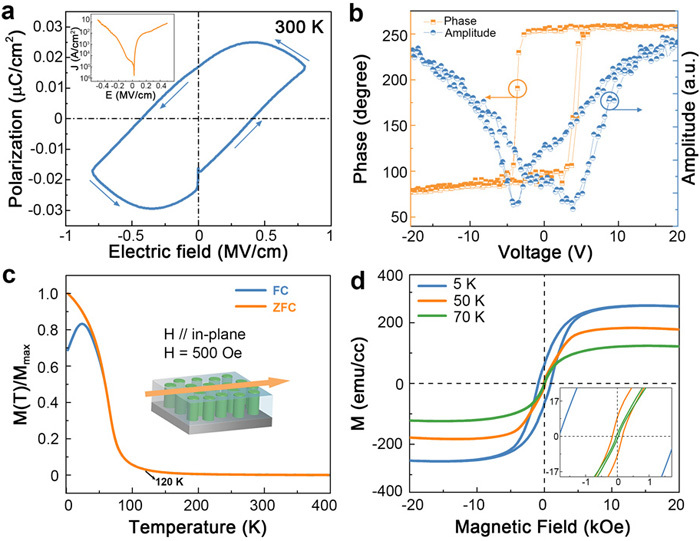
Investigation of ferroelectric and ferromagnetic properties in SrMnO₃:NiO films (Image by IMR)
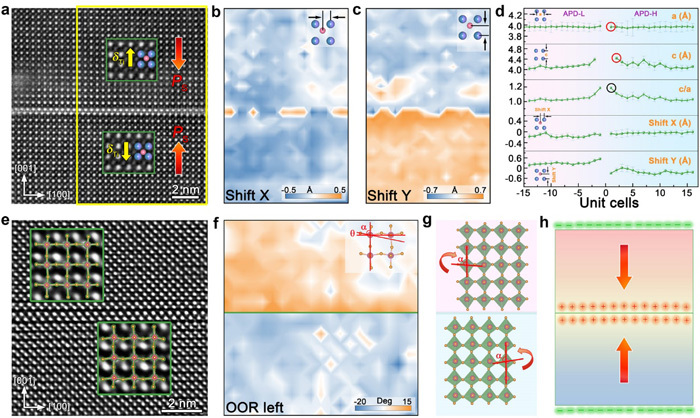
Atomic and polarization characteristics of in-plane large-scale charged domain walls in Na₀.₅Bi₀.₅TiO₃ films (Image by IMR)