Researchers from the Institute of Metal Research, Chinese Academy of Sciences (IMR, CAS), have discovered the first all-temperature barocaloric effect in an inorganic plastic crystal material, KPF₆. This breakthrough enables a single material to cover the entire range of typical refrigeration temperatures from room temperature down to liquid helium temperatures, representing a significant advancement in solid-state refrigeration technology.
Solid-state refrigeration based on phase transitions offers a promising alternative to conventional vapor-compression systems due to its environmental friendliness and energy efficiency. However, existing caloric materials – such as magnetocaloric gadolinium or barocaloric neopentylglycol – typically exhibit cooling effects only within narrow temperature ranges (±10 K) around their phase transition points, requiring multiple materials with different transition temperatures for broad-temperature applications.
The research team's discovery in KPF₆ overcomes this fundamental limitation. Using self-developed equipment for measuring adiabatic temperature changes, they demonstrated that KPF₆ produces substantial cooling effects across an unprecedented temperature span: 12 K at room temperature and 2.5 K at 77.5 K under 250 MPa pressure.
By combining in-situ high-pressure Raman spectroscopy, neutron diffraction measurements at Japan's J-PARC facility, and first-principles calculations, the researchers constructed a comprehensive pressure-temperature phase diagram and revealed the material's structural evolution under different conditions.
"This is the first and only solid-state caloric material demonstrating cooling capability across such a broad temperature range," said the research team. "KPF₆'s unique property originates from its multiple pressure-induced phase transitions that occur at different temperatures, enabling continuous refrigeration from room temperature down to cryogenic regions."
The discovery opens new possibilities for developing simplified, efficient refrigeration systems that could operate across multiple temperature regimes using a single material, with potential applications in quantum computing, space exploration, and advanced cooling technologies.
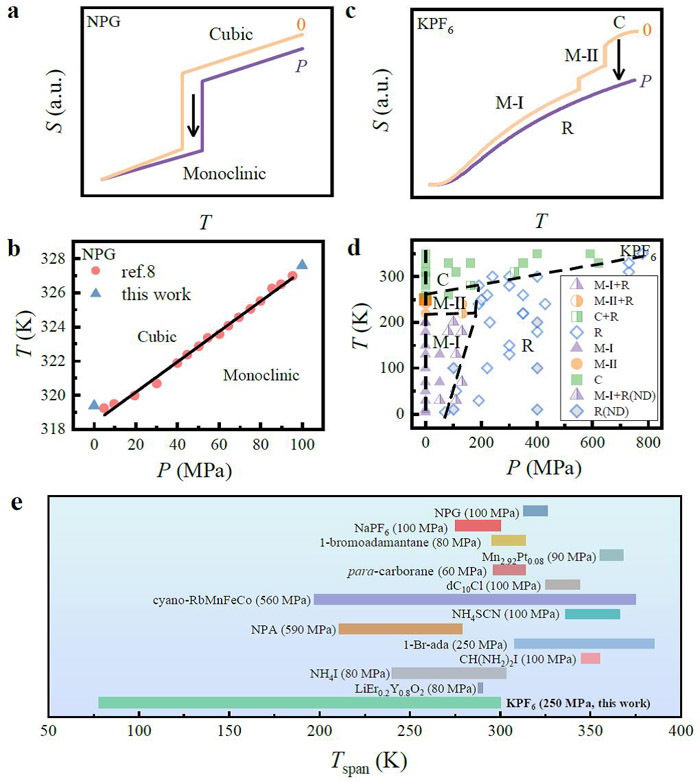
Comparison between traditional barocaloric effect and full-temperature-range barocaloric effect (Image by IMR)