Polycrystalline materials with excellent room-temperature plasticity are typically metallic materials with high-symmetry structures. Generally, higher structural symmetry leads to more equivalent slip systems that can be activated, resulting in better plasticity. However, recent studies have found that monoclinic Ag₂S-based inorganic semiconductors with lower symmetry exhibit exceptional plasticity comparable to metals. This appears to contradict the conventional empirical rule, and the underlying deformation mechanism remains unclear. On the other hand, Ag₂S materials are highly susceptible to ion and electron irradiation, making microstructural characterization extremely challenging. So far, there has been almost no direct or clear observation of their microstructure, and the study of their plastic deformation mechanisms presents significant difficulties.
Recently, Prof. LI Xiuyan from the Institute of Metal Research, Chinese Academy of Sciences (IMR, CAS), in collaboration with Prof. WEI Tianran from Shanghai Jiao Tong University and Prof. SHI Xun from the Shanghai Institute of Ceramics, Chinese Academy of Sciences, selected Ag₄SSe plastic semiconductors—which share the same monoclinic structure as Ag₂S and exhibit greater stability under electron irradiation—as the research subject. Through high-pressure torsion (HPT) plastic deformation and transmission electron microscopy (TEM), the team successfully observed and analyzed the microstructural evolution of the material. The related work has been published in the journal Science Advances under the title ”The structural origin of extraordinary plasticity in polycrystalline semiconductors with low symmetry.”
Monoclinic polycrystalline Ag₄SSe semiconductors exhibit excellent room-temperature plasticity, achieving tensile, bending, and compressive strains of up to 25%, 40%, and 50%, respectively. They can even be plastically processed into high-performance semiconductor springs. The study revealed that the monoclinic structure contains a high-symmetry anion sub-lattice resembling a quasi-body-centered cubic (quasi-BCC) structure, which provides multiple active slip systems and effectively promotes plastic deformation. Using high-resolution transmission electron microscopy, the team clearly observed four slip planes—(011), (021), (031), and (010)—in the heavily deformed samples, corresponding to the typical ( ), (
), ( ), (
), ( ), and (
 ) slip planes in the quasi-cubic structure, respectively. Theoretical calculations further demonstrated that these slip systems generally exhibit low slip energy barriers, while Ag ions exhibit large vibrational displacements, effectively accommodating the relative sliding of the anion sub-lattice.
These findings elucidate the microstructural mechanisms underlying the plastic deformation of low-symmetry Ag₂S-based polycrystalline semiconductors, laying a foundation for exploring novel plastic semiconductors and enriching the theory of plastic deformation in materials.
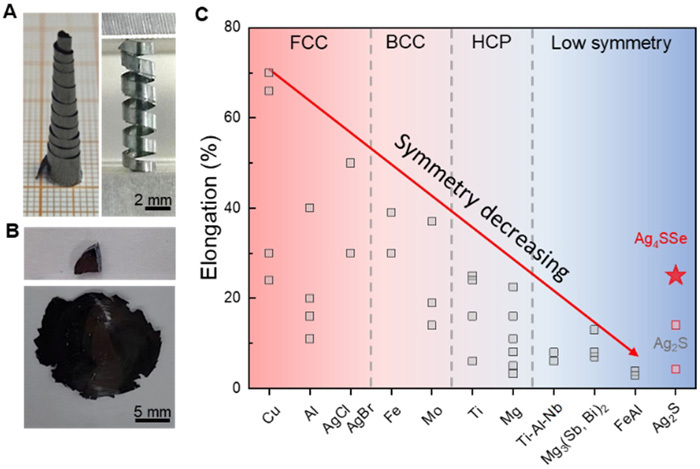
Excellent room-temperature plasticity of Ag₄SSe and the room-temperature elongation of materials with different structures (Image by IMR)
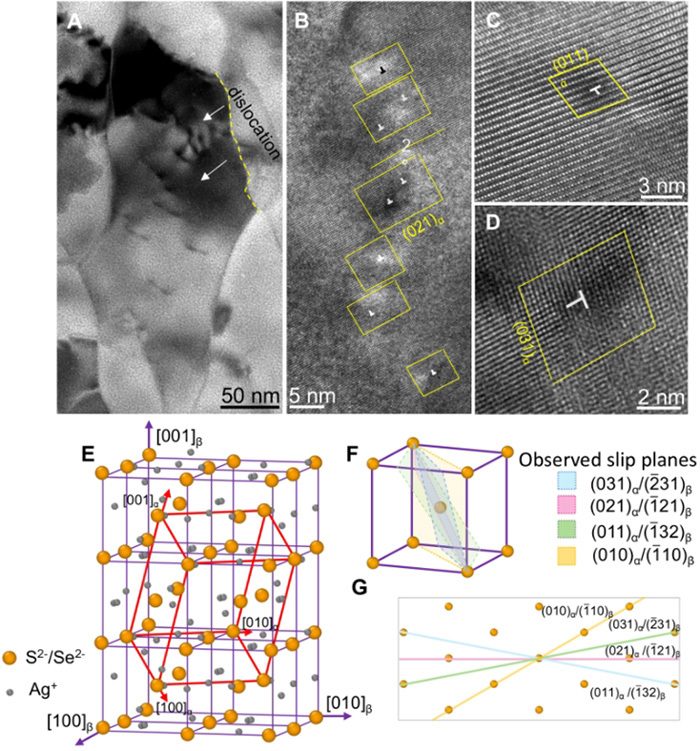
HRTEM images of dislocations in deformed Ag₄SSe and the corresponding slip planes in the quasi‑BCC anion sub‑lattice (Image by IMR)