Due to strong absorption of solar ultraviolet light with wavelengths shorter than 280 nm by atmospheric ozone layer, the background radiation signal in this spectral band at the Earth's surface is nearly zero. Consequently, this band is referred as the "solar-blind" region. UV photodetectors operating within this band offer advantages such as low background noise, high sensitivity, and low false-alarm rates, making them widely applicable in critical fields like flame monitoring, aerospace, industrial control, and environmental detection. An ideal solar-blind detector must not only possess excellent spectral selectivity but also maintain stable operation in extreme environments, such as high temperatures. However, the performance of existing mainstream commercial silicon-based UV detectors drastically deteriorates in environments above 125 °C, severely limiting their application in high-temperature scenarios. In contrast, diamond is considered as an ideal material for high-performance optoelectronic devices under extreme conditions due to its exceptional thermal conductivity, wide bandgap, high breakdown electric field, and chemical stability. Nevertheless, under high-temperature conditions, an oxygen-terminated structure featuring numerous surface state defects is always produced on the diamond surface, degrading the photodetection performance of devices in extreme environments.
To address these challenges, a collaborative research effort led by the groups of Prof. SUN Dongming and Prof. HUANG Nan at the Shenyang National Laboratory for Materials Science, Institute of Metal Research, Chinese Academy of Sciences, proposed a novel structure: single-crystal diamond nanowires embedded with platinum nanoparticles. This design effectively enhances the solar-blind UV photodetection performance of diamond in high-temperature environments. The structure integrates the superior charge carrier transport capability of one-dimensional nanowires, the localized surface plasmon resonance effect of Pt nanoparticles, the localized Schottky barriers at the Pt/diamond interface, and a photoconductive gain mechanism induced by deep-level traps at elevated temperatures. This synergistic combination offers significant advantages in enhancing light absorption, carrier generation, and separation efficiency, thereby substantially improving the photoresponse capability of oxygen-terminated diamond under high temperatures. The related research findings have been published in the authoritative journal Nano-Micro Letters on April 16, 2025, under the title "Single-Crystal Diamond Nanowires Embedded with Platinum Nanoparticles for High-Temperature Solar-Blind Photodetector."
In the specific study, researchers successfully fabricated high-crystallinity single-crystal diamond nanowires embedded with platinum nanoparticles through a process involving thermal oxidation treatment of [001]-oriented micro/nano diamond composite films, followed by platinum film deposition, annealing-induced dewetting, and epitaxial homogeneous growth (Figures 1 and 2). Under 220 nm UV illumination and a 20 V bias, a device constructed from this material achieved a responsivity of 68.5 A/W, representing an approximately 2000-fold improvement compared to traditional oxygen-terminated bulk diamond devices, with a UV/visible rejection ratio of 550 (Figure 3). More notably, when the operating temperature was increased to 275 °C, the device's responsivity at 220 nm surged to 3098.7 A/W, and the UV/visible rejection ratio reached as high as 4303, demonstrating good stability and repeatability (Figure 4).
This research marks the first significant breakthrough in the high-temperature performance of diamond-based solar-blind UV detectors achieved through innovative design at the diamond nanowire material level. It validates the effectiveness of embedding metal nanostructures for enhancing the optoelectronic properties of oxygen-terminated diamond, providing a novel design concept and experimental basis for developing high-performance UV detectors for extreme environments.
The first author of the paper is LU Jiaqi, a doctoral student at the Institute of Metal Research, Chinese Academy of Sciences. The corresponding authors are Associate Prof. YANG Bing and Prof. SUN Dongming. Prof. CHENG Huiming, and Prof. Xin Jiang from the University of Siegen, Germany, also provided significant guidance for the research.
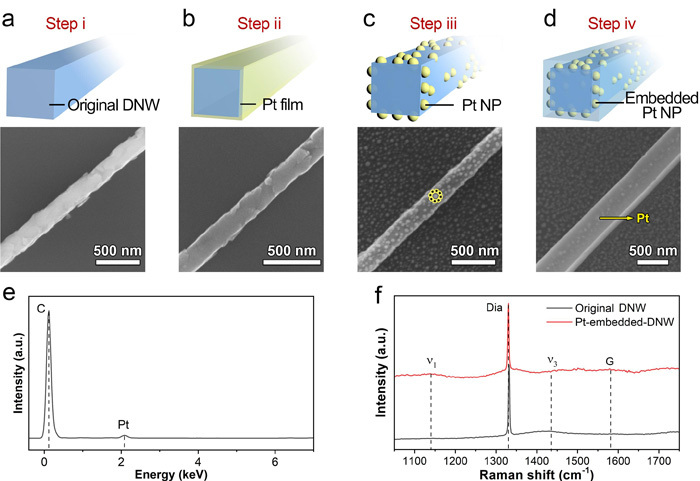
Figure 1. Fabrication of single-crystal diamond nanowires embedded with Pt nanoparticles(Image by IMR)
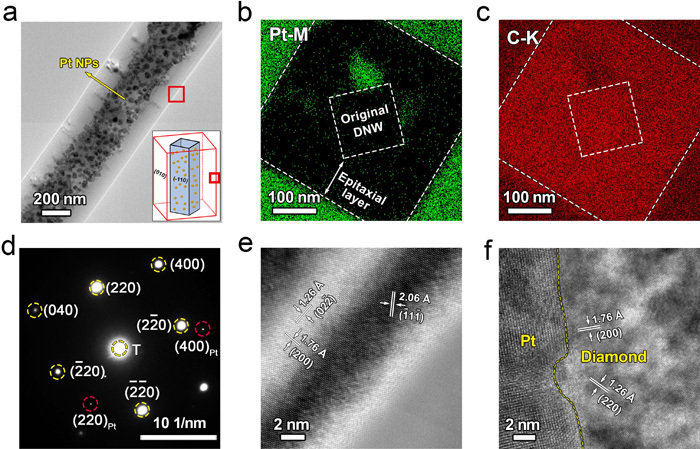
Figure 2. Microstructural characterization of the single-crystal diamond nanowires (Image by IMR)
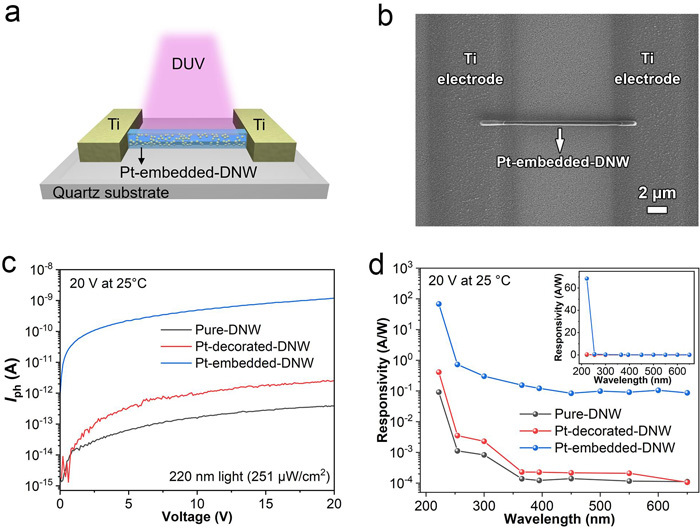
Figure 3. Room-temperature solar-blind UV photodetection performance of the single-crystal diamond nanowire photodetector (Image by IMR)
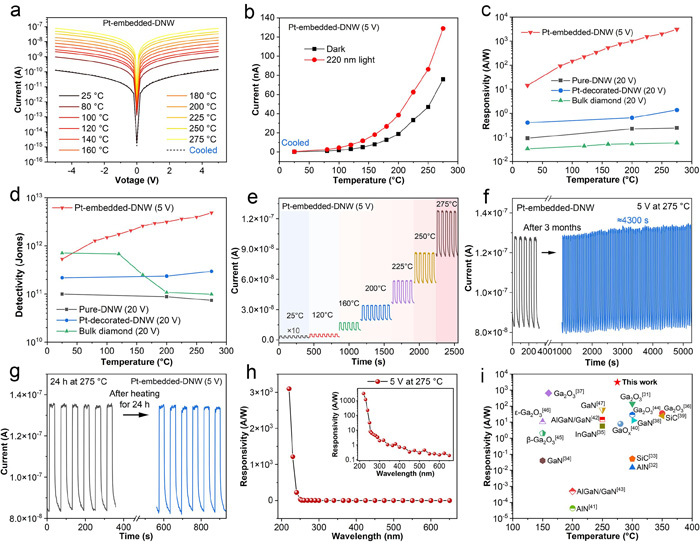
Figure 4. High-temperature solar-blind UV photodetection performance of the single-crystal diamond nanowire photodetector (Image by IMR)