Flexible perovskite solar modules (f-PSMs) represent a pivotal innovation in current renewable energy technologies, offering a pathway toward sustainable and efficient energy solutions. However, achieving operational stability without compromising efficiency or escalating material costs remains a critical challenge.
A joint research team from the Shenyang National Laboratory for Materials Science at the Institute of Metal Research, Chinese Academy of Sciences (IMR, CAS) together with the Zhengzhou University, has achieved significant breakthrough in maintaining a remarkable power conversion efficiency (PCE) surpassing 20% withstanding various external stresses.
The study, published in Joule, explores the application of single-walled carbon nanotubes (SWCNT) as window electrodes in the fabrication of scalable f-PSMs. SWCNT films exhibit excellent hydrophobicity, resisting moisture-induced degradation while enhancing device stability. Moreover, SWCNT-based devices retain mechanical flexibility and affordability, making them practical and durable uses for sustainable, cost-effective energy systems, balancing opportunities and challenges ahead, and providing the ideal opportunity for building and infrastructure to its own power source for a net carbon zero future.
This work introduced H₂SO₄ to treat the SWCNT network and discovered that H₂SO₄ not only enhances the conductivity of the SWCNT films but also interacts with NiOx to form a compact NiSO₄-NiOx layer. This interaction further promotes charge transfer between perovskite and hole transport material, resulting in ITO-free PSCs with over 24% PCE and enhanced stability (~23% for f-PSCs). These devices maintained over 95% of their original PCEs under various external stresses, including high temperature, high humidity, and continuous solar irradiation for one month.
Furthermore, the straightforward and scalable fabrication method enabled the module-scale flexible ITO-free device to achieve over 20% PCE, accompanied by markedly enhanced stability and bendability. Moreover, the SWCNT films can be fabricated on a meter-scale via a CVD-integrated roll-to-roll process, offering a viable pathway for scaling up SWCNT-based modules.
The findings herein underscore the performance advantages of SWCNT electrodes treated with conventional acidic methodologies.
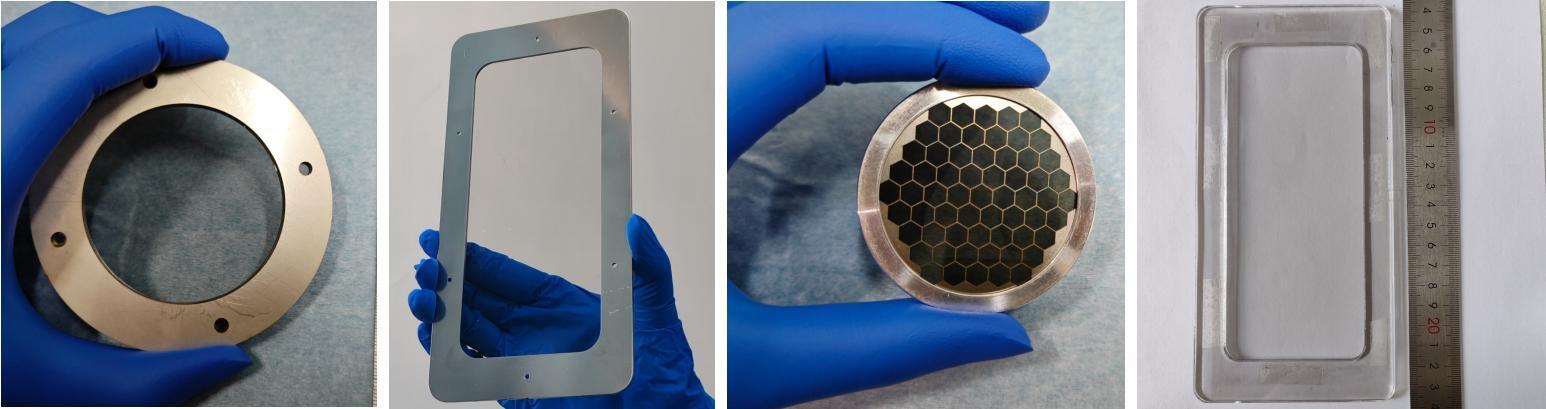
SWCNT films suspended on different substrates (Image by IMR)