The crucial point of spintronic devices lies in utilizing spin currents to transfer momentum, thereby achieving low-energy, high-speed storage and logical signal control. Spintronic devices are typically manipulated by electric currents and fields, with the charge-to-spin conversion efficiency (CSE) being a key metric for evaluating device performance. Currently, there are mainly two different mechanisms for controlling spin currents in spintronic devices: The spin-transfer torque (STT) that enables spin manipulation, but limited by spin scattering. Moreover, its longitudinal spin polarized current leads to an inseparable read/write channel problem in magnetic tunnel junction devices. Although the spin-orbit torque (SOT) mechanism enables transverse signals, it faces the bottleneck of short spin diffusion lengths, causing rapid attenuation of spin currents during propagation and limiting spin angular momentum injection efficiency. Therefore, a spintronic material with both large CSE and long spin diffusion length is desired.
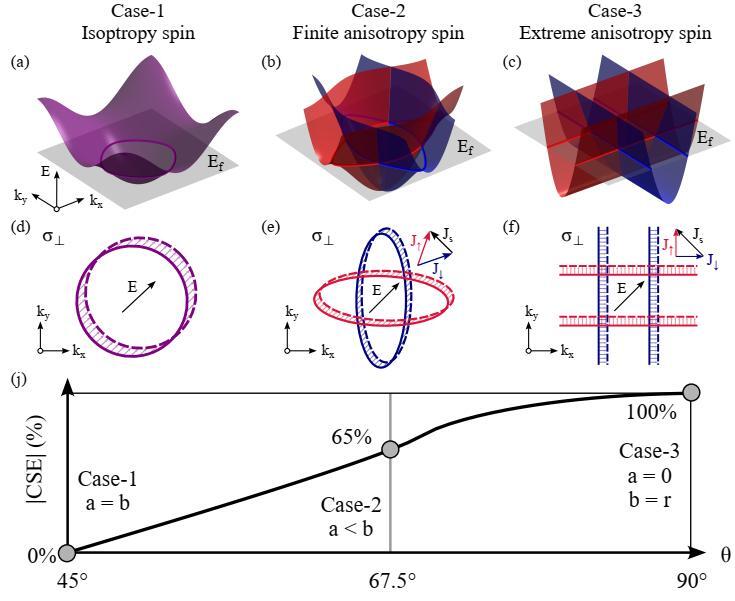
Effective model of altermagnets with different spin-splitting anisotropy (Image by IMR)
Distinct from above mechanisms of spin transfer torque and spin-orbit torque, scientists from Materials Artificial Intelligence Division at the Shenyang National Laboratory for Materials Science, Institute of Metal Research, Chinese Academy of Sciences (IMR, CAS), have proposed the deep correlation between the Spin Splitting Torque (SST) and the Fermi surface geometry. The results were recently published in Physical Review Letters with the title of "d-Wave Flat Fermi Surface in Altermagnets Enables Maximum Charge-to-Spin Conversion".
By constructing an effective model for Fermi surface anisotropy, the correspondence between Fermi surface geometry and the CSE was elucidated and the quantum limit (100%) for CSE are expected in a system with flat Fermi surface geometry. In conventional antiferromagnetic systems, spin currents are not generated. In altermagnets, spin splitting originating from magnetic order rather than the relativistic effects of spin-orbit coupling can naturally lead to long spin diffusion lengths. When the spin-anisotropic splitting in the system increases, it induces a time-reversal-odd (T-odd) spin current, resulting in finite CSE. Furthermore, when a flat Fermi surface geometry emerges, d-wave spin anisotropy can realize the quantum limit for T-odd CSE.
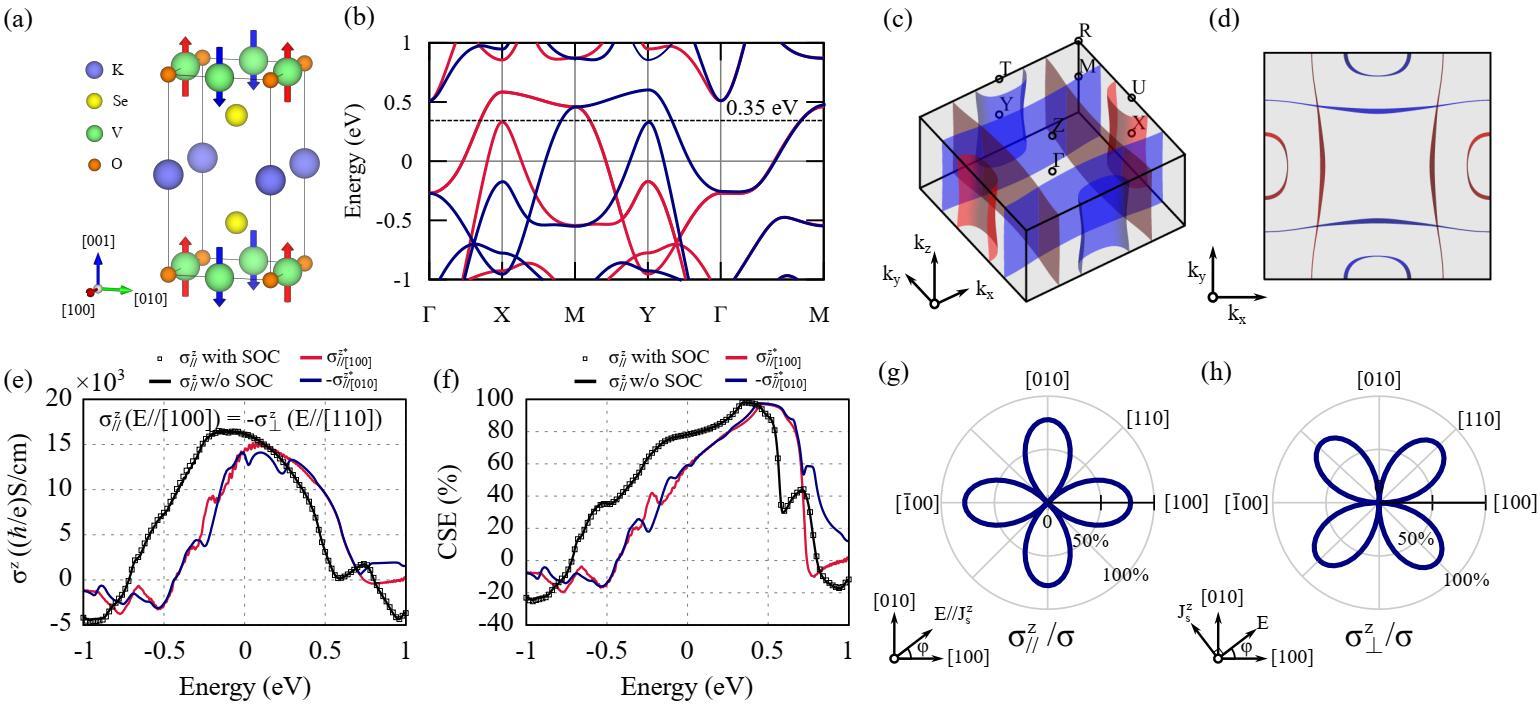
Crystal structure, band structure, and spin-current characteristics of KV2Se2O (Image by IMR)
Inspired by the model analysis, scientists performed theoretical calculations on the room-temperature d-wave altermagnet KV₂O₂Se. The results reveal the presence of a flat Fermi surface with nearly negligible dispersion along the kz direction in KV₂O₂Se. Moreover, two sets of perpendicular Fermi surfaces are occupied by opposite spin panels, which aligns remarkably well with the scenario uncovered in the theoretical modeling, indicating the potential for an exceptionally large CSE. According to practical calculations, the material can generate transverse and longitudinal spin currents along [110] and [100] directions. The CSE reaches 78% at the charge neutrality point and it can reach up to 98% under slight electron doping. Furthermore, we found that the high CSE in KV₂O₂Se exhibits strong robustness against the effects of temperature and defects.
Scientists also take a comprehensive comparison with all other reported T-odd spin current materials. The CSE of KV₂O₂Se at the charge neutrality point is significantly higher than that of other altermagnets, and twice that of the prominent material RuO₂, setting a new record for T-odd CSE efficiency. Moreover, the spin conductivity of KV₂O₂Se reaches 3.2×10⁴ (ħ/2e) (S/cm) in both transverse and longitudinal directions, with its current density surpassing that of the most intrinsic magnetic materials. This work proposes the new strategy of "Fermi surface geometry engineering" to tune spin-related properties of materials toward the quantum limit and suggests promising candidate materials.
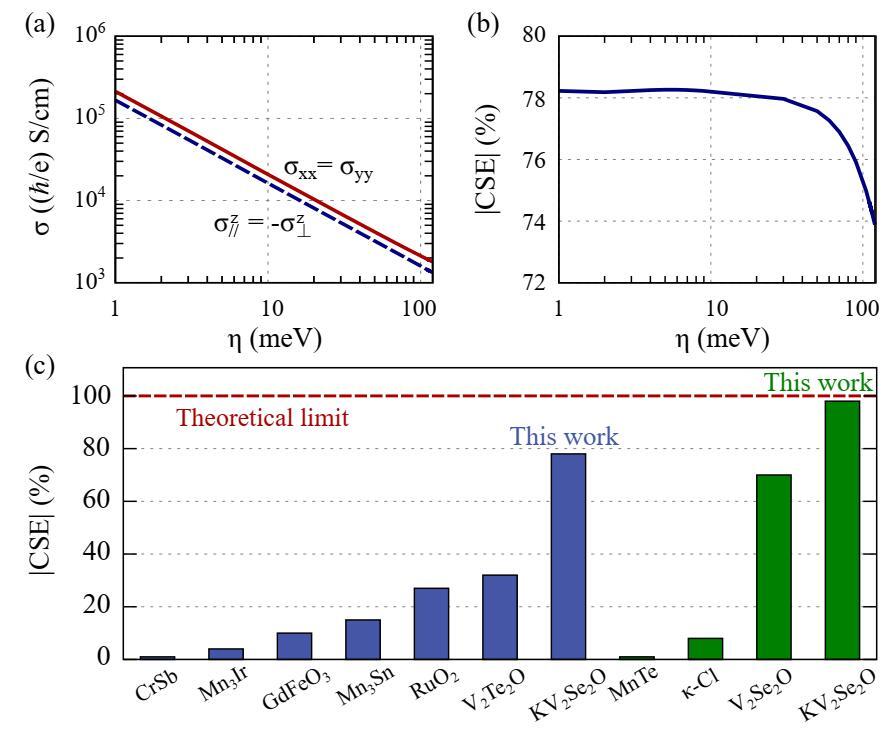
Conductivity, spin conductivity, and CSE of KV2Se2O, in comparison with other altermagnets (Image by IMR)