Inspired by the remarkable adaptability of the human eye, researchers from the Shenyang National Laboratory for Materials Science, the Institute of Metal Research, Chinese Academy of Sciences (IMR, CAS), have developed a novel phototransistor with tunable sensitivity. This breakthrough offers a new, efficient solution for detecting low-contrast targets in complex visual environments, a critical challenge for advanced machine vision systems in applications such as precision guidance and smart surveillance. The results were recently published in Light: Science & Applications with the title of "Bioinspired phototransistor with tunable sensitivity for low-contrast target detection".
Conventional photodetectors often struggle to generate a significant electrical response to faint differences in light intensity, causing subtle targets to be lost in background noise. While the human retina can dynamically adjust its sensitivity to focus on specific intensity ranges, mimicking this "on-demand" adaptive mechanism in compact electronic devices has been difficult.
To overcome this, the research team, led by Prof. SUN Dongming, Prof. LIU Chi, and Academician CHENG Huiming, drew direct inspiration from biology. They ingeniously integrated a specially designed photosensitive structure into the gate of a molybdenum disulfide (MoS₂) transistor. This key component is a heterojunction diode made of pristine MoS₂ and oxygen-plasma-treated MoS₂. Much like the photoreceptive proteins in our eyes, the electrical conductivity of this diode changes dynamically with incident light intensity. This change alters the internal voltage distribution within the transistor, allowing its sensitivity window to be precisely tuned by an external gate voltage.
Consequently, the device can be set to respond dramatically only to a pre-selected, narrow range of light intensities—exactly where a low-contrast target's signature lies—while effectively ignoring brighter or dimmer background noise. Experimental results are striking: compared to traditional photodetectors, this bioinspired device achieves over a 1,000-fold improvement in sensitivity for detecting minute light variations and exhibits exceptional noise immunity.
When configured into an array for imaging, the technology clearly outperforms conventional sensors. It can stably and clearly identify patterns with very weak contrast against their background, paving the way for next-generation, compact machine vision systems capable of seeing what current technology easily misses.
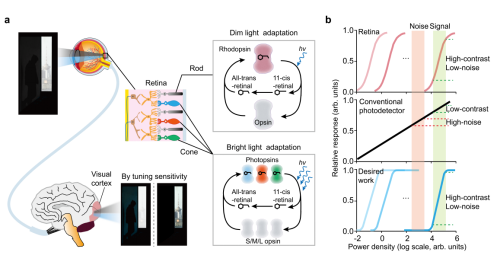
Bioinspired phototransistor with tunable sensitivity. a Human visual perception via light adaptation in the retina under different lighting conditions. The sensitivity of rod and cone cells is dynamically adjusted according to ambient light intensity, enabling efficient perception under both bright and dim light. b Comparison of light-response characteristics among the human retina, conventional photodetectors, and the bioinspired photodetector. Both the retina and the bioinspired detector can enhance the relative light intensity difference between target and background while effectively suppressing irrelevant noise. In contrast, conventional photodetectors, due to their fixed sensitivity and linear response, struggle to effectively identify low-contrast targets. (Image by IMR)
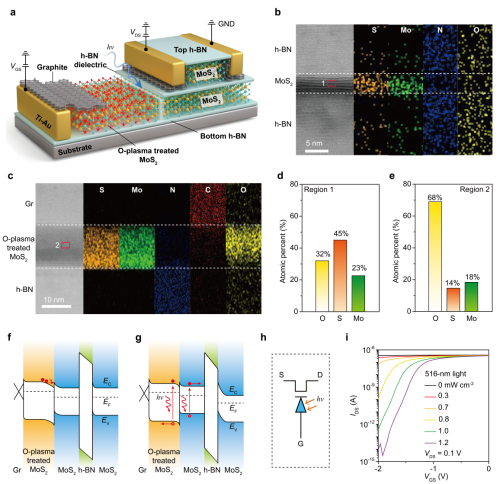
Structure and working principle of the tunable-sensitivity phototransistor. a Schematic diagram of the tunable-sensitivity phototransistor, integrating a MoS₂ field-effect transistor with a photodiode. Hexagonal boron nitride (h-BN) serves as both the dielectric and protective layer, while graphite forms the contact and gate electrodes. b, c Cross-sectional high-resolution transmission electron microscopy images of key heterostructures in the device, showing clear interfaces and well-defined layers. d, e Elemental composition analysis of MoS₂ before and after oxygen plasma treatment, confirming the formation of the photodiode. F, g Schematic band diagrams of the device under dark and illuminated conditions, illustrating the light-induced electrical modulation mechanism. h Equivalent circuit diagram of the device. i Transfer characteristic curves of the device under dark conditions and illumination at different light intensities, demonstrating effective modulation of the photoresponse by both light intensity and gate voltage. (Image by IMR)
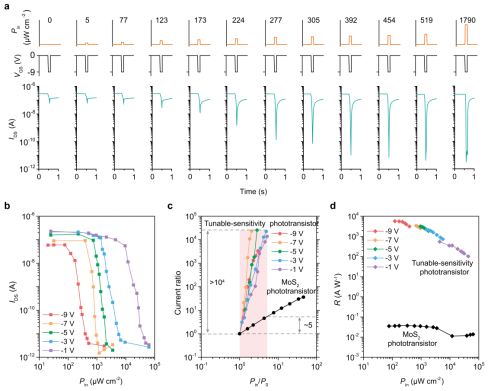
Optoelectronic performance of the tunable-sensitivity phototransistor. a Photoresponse behavior of the device under different light intensities and gate voltages, showing effective tuning of the optoelectronic response via the gate voltage. b Relationship between device current and incident light intensity under different gate voltages, highlighting the enhanced response within specific intensity ranges. c Comparison of current change between the tunable-sensitivity phototransistor and a conventional phototransistor under varying light intensities, showing the device's ability to amplify target light intensity variations while suppressing irrelevant background signals. d Comparison of responsivity between the tunable-sensitivity phototransistor and a conventional phototransistor under different light intensities, demonstrating the significant advantage of the former under low-light and low-contrast conditions. (Image by IMR)
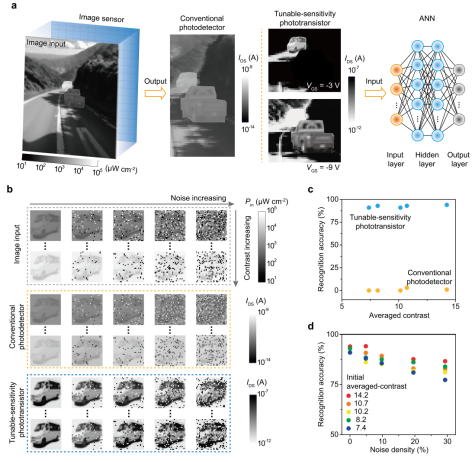
Robust recognition capability for low-contrast targets. a Schematic diagram of an intelligent machine vision system integrated with a tunable-sensitivity phototransistor array. b Imaging comparison between a conventional phototransistor array and the tunable-sensitivity phototransistor array, showing that the latter can more clearly highlight target features under low-contrast conditions. c Comparison of recognition accuracy between the tunable-sensitivity phototransistor and the conventional phototransistor under different average contrast conditions, indicating the clear advantage of the former in complex lighting environments. d Recognition results under salt-and-pepper noise interference, showing that the tunable-sensitivity phototransistor maintains high recognition robustness even in strong noise environments. (Image by IMR)