In a significant advance for next-generation microelectronics, scientists have discovered a way to overcome a fundamental size limitation in a key lead-free piezoelectric material. The research, accepted for publication in Science Advances, demonstrates that carefully engineered ultra-thin films of BiFeO3 could exhibit a piezoelectric response more than four times greater than conventional forms of the material.
Piezoelectric materials, which convert mechanical stress into electricity and vice versa, are essential components in sensors, actuators, and energy-harvesting devices. However, the performance of the leading lead-free candidate, BiFeO3, plummets when its films are thinner than about 30 nm—a critical barrier for miniaturizing devices like those found in smartphones and medical implants.
An international team led by researchers from the Institute of Metal Research, Chinese Academy of Sciences has now broken this “thickness limit”. By constructing specially engineered multilayer heterostructures, they discovered and stabilized a transient “S-phase” within the ultra-thin BiFeO3 films. This metastable phase facilitates a rotation of the material’s polarization, unlocking its latent piezoelectric potential even at thicknesses of just a few nanometers.
“This work demonstrates that electric dipoles in BiFeO3 could strongly couple with interfacial strain and their local atomic environment, giving rise to novel polarization configurations that are critically important for tuning the piezoelectric response.” explains Prof. TANG Yunlong, the corresponding author. “It’s like finding a new gear in a tiny engine, allowing it to do powerful work despite being just a few nanometers thick.”
Using atomic-scale imaging and quantitative electromechanical microscopy, the team directly observed this S-phase and measured a piezoelectric coefficient (d33 ≈ 30 pm/V) in 16-unit-cell-thick films—a value four times higher than standard rhombohedral BiFeO3. This finding not only provides a new design strategy for high-performance, eco-friendly piezoelectrics but also paves the way for their integration into ultra-miniaturized sensors, actuators, and micro-electromechanical systems (MEMS).
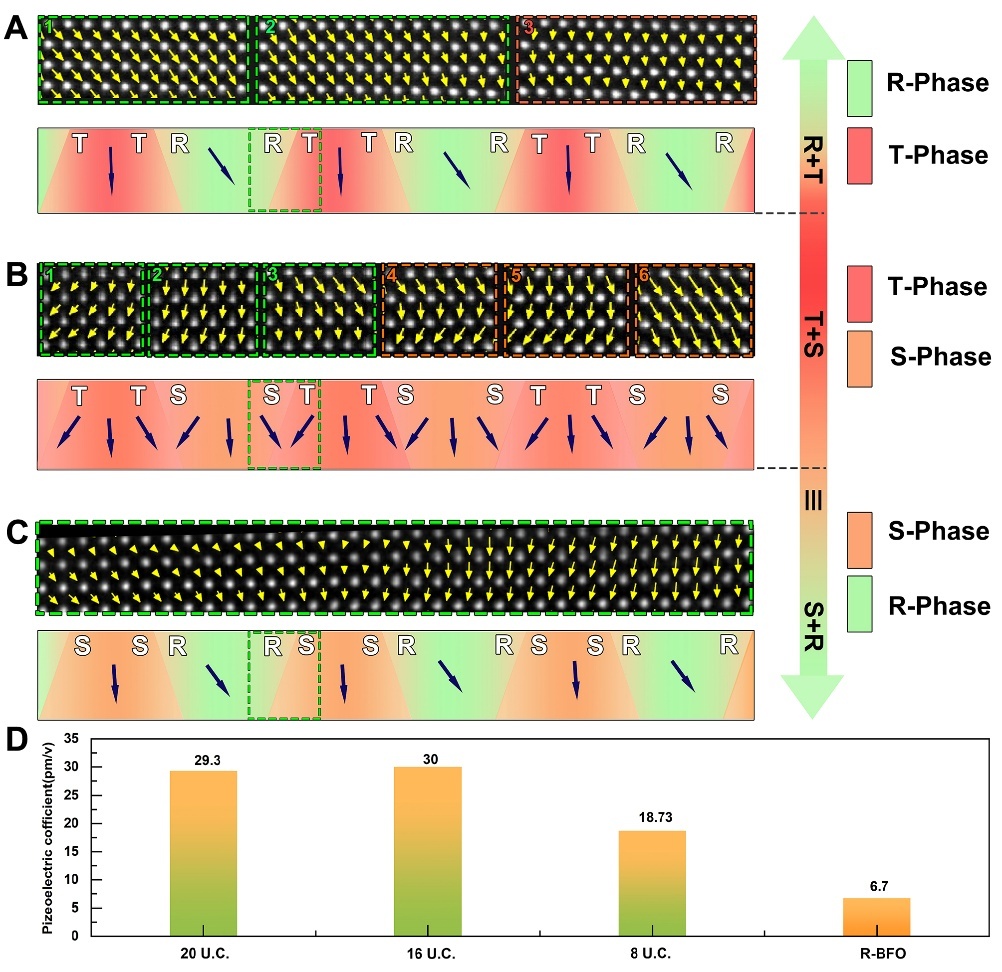
Polarization analysis, thickness-dependent piezoelectric response and d33 statistics of the (BiFeO3/Ca0.96Ce0.04MnO3)4 multilayers grown on LaAlO3 substrates (Image by IMR)