Chinese scientists have discovered a strong interplay between polar topological structures and one-dimensional structural defects in antiferroelectric materials, opening a new paradigm for designing topological states in condensed matter physics.
Antiferroelectrics, which feature oppositely aligned electric dipoles in neighboring crystal cells, have long been considered difficult to host continuous polarization rotations due to large energy barriers. This has limited their potential for hosting novel polar topologies similar to those found in ferroelectrics.
A collaborative team from the Institute of Metal Research, Chinese Academy of Sciences, Songshan Lake Materials Laboratory, and other institutions took an alternative approach by focusing on dislocations—the most common one-dimensional topological defects in crystals. Using atomic-resolution transmission electron microscopy, they observed that dislocation cores at interfaces in high-quality PbZrO₃ thin films act as convergence points for electric polarization vectors.
The periodic strain fields created by these dislocation arrays strongly couple with electric dipoles, spontaneously inducing an ordered lattice of "antihedgehog" polar domains between dislocations. This represents an entirely new polar topological structure in antiferroelectrics.
Phase-field simulations revealed the underlying mechanism: electrostrictive and flexoelectric effects near dislocation cores generate local effective electric fields strong enough to overcome the inherent antiparallel coupling in antiferroelectrics, driving polarization rotation and reconfiguration.
"This work demonstrates that dislocations, traditionally viewed as crystal defects, can serve as a new tool for engineering polar topological states," said Prof. TANG Yunlong, corresponding author of the study published in Nature Communications on March 13, 2026.
The finding establishes a new defect-engineering paradigm for designing polar topologies in antiferroelectrics and provides a material platform for developing high-density memory and novel logic devices based on these materials.
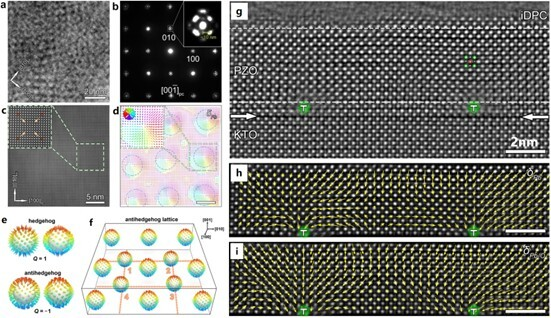
Strong interplay between one-dimensional topological defects (dislocations) and polar topological structures in antiferroelectric PbZrO₃ ultrathin films. (a) Plan-view TEM image showing periodic lattice contrast; (b) Plan-view electron diffraction pattern; (c) Plan-view atomic-resolution image; (d) Corresponding polarization vector map; (e) Schematic of hedgehog and antihedgehog domain structures; (f) Three-dimensional tetragonal lattice of antihedgehog domains; (g) Cross-sectional atomic-resolution image of all elements in the ultrathin film; (h, i) Polarization displacement vector maps of Pb atoms and Pb-O atomic pairs, respectively. (Image by IMR)

Characterization of atomic composition at interfacial dislocation cores and piezoelectric properties of the antiferroelectric PbZrO₃ thin film. (Image by IMR)