Inspired by nature, Chinese scientists have developed a series of high-performance materials that overcome traditional trade-offs between strength, toughness, and functional properties, opening new pathways for next-generation structural materials operating under extreme conditions.
Structural materials determine the performance and reliability of critical equipment, from deep-sea vessels to high-speed vehicles. However, material design has long faced a fundamental dilemma: increasing strength typically comes at the cost of reduced plasticity and damage tolerance. Similar trade-offs often exist between mechanical properties and functional performance. Simultaneously improving mechanical and functional properties has remained a major challenge, with conventional alloying and microstructural control approaching their theoretical limits.
Drawing inspiration from biological materials such as shells, bone, and bamboo—which achieve remarkable combinations of properties through multiscale architectures despite simple chemical compositions—researchers led by Prof. LIU Zengqian from the Institute of Metal Research, Chinese Academy of Sciences, in collaboration with multiple institutions, have developed a two-step "scaffold construction + melt infiltration" strategy for fabricating bioinspired metallic materials. This approach decouples microstructural building from overall material forming, enabling precise construction of complex architectures previously unattainable in metals.
Using this strategy, the team has achieved multiple breakthroughs across different material systems. A gradient ceramic mimicking the "hard outside, tough inside" structure of seashells simultaneously enhances strength, energy absorption, and fracture toughness. A bone-inspired 3D interpenetrating-phase composite for implants provides both mechanical support and bioactive functions promoting bone regeneration. A multiscale-structured cast high-entropy alloy achieves an unprecedented combination of ultrahigh strength (>1600 MPa) and high plasticity (~11%).
The bioinspired approach has also been extended to engineering materials: tungsten-copper composites for high-voltage electrical contacts exceed existing strength limits from room to elevated temperatures, while 3D-printed aluminum alloys with nanoscale crystalline-amorphous network composite structures demonstrate exceptional thermal stability and high-temperature specific strength surpassing titanium alloys.
The research provides a new paradigm for achieving strength-toughness synergy and structural-functional integration in metallic materials, offering innovative solutions for reliable performance under extreme service conditions. The findings have been published in multiple journals including Progress in Materials Science, Advanced Materials, Materials Today, Advanced Functional Materials, Scripta Materialia and Interdisciplinary Materials.
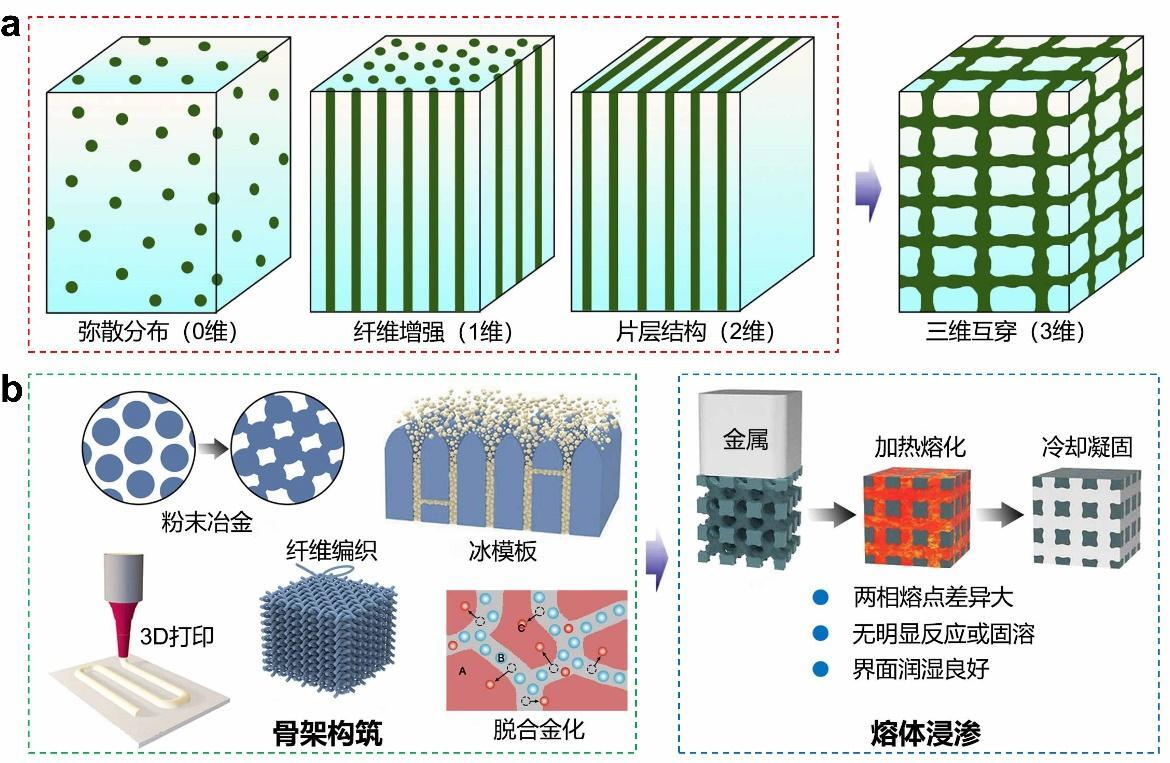
Design of bioinspired three-dimensional interpenetrating phase architecture and fabrication strategy for corresponding bioinspired materials. (Image by IMR)
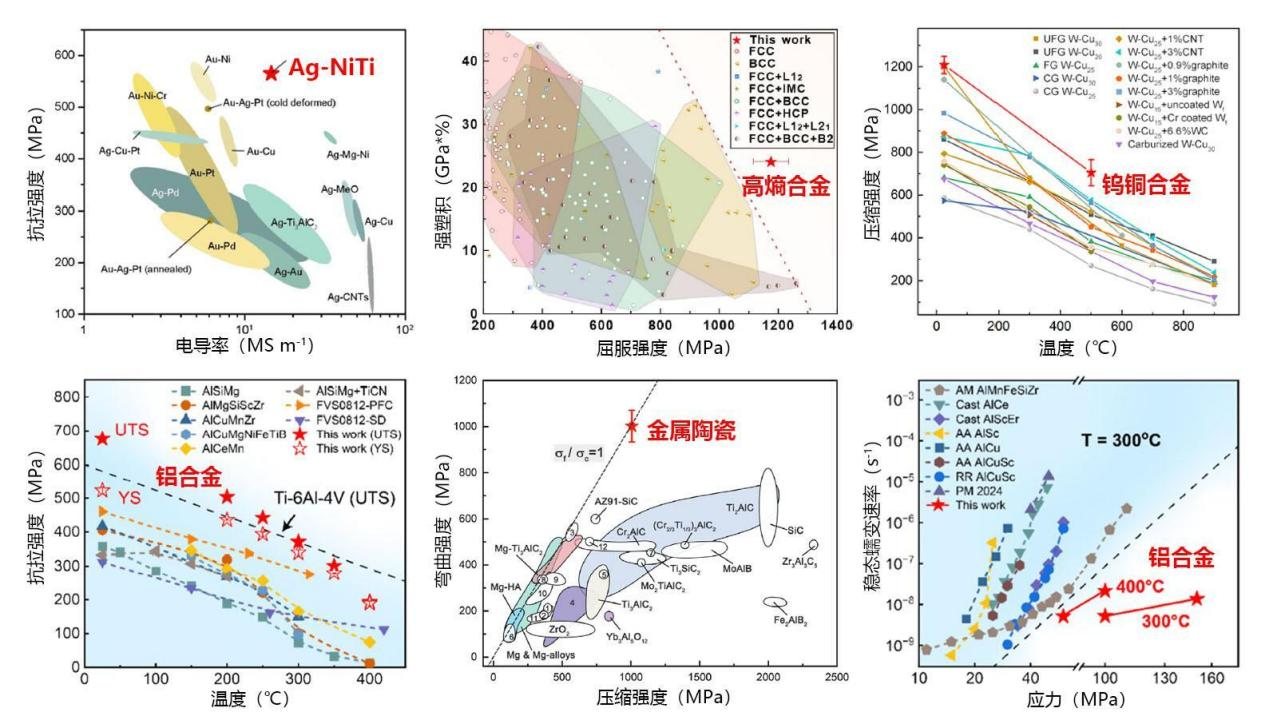 The developed series of novel bioinspired materials push multiple performance boundaries of existing materials. (Image by IMR)