A research team from the Institute of Metal Research, Chinese Academy of Sciences has discovered that specific grain boundaries in magnetite (Fe₃O₄) exhibit substantially higher electrical conductivity than the surrounding grain interiors, overturning the long-held belief that grain boundaries inevitably degrade electrical transport.
Grain boundaries are ubiquitous in polycrystalline materials and play a decisive role in determining mechanical strength and physical properties. For structural applications, they impede dislocation motion, leading to the well-known Hall-Petch strengthening. For functional materials, their unique atomic arrangements often give rise to novel phenomena, making grain boundary engineering a powerful strategy for property optimization. However, when it comes to electrical conductivity, grain boundaries typically act as barriers. Atomic disordering and chemical discontinuities at boundaries scatter charge carriers and block current, severely limiting the performance of many electronic devices.
Researchers led by Prof. CHEN Chunlin have now turned this conventional wisdom on its head. Using pulsed laser deposition, the team epitaxially grew high-quality Fe₃O₄ bicrystal thin films containing single, well-defined Σ5 and Σ13 grain boundaries. Nano- to macro-scale electrical measurements revealed that both types of grain boundaries conduct electricity significantly better than the grain interior—a first in the study of oxide grain boundaries.
To understand this counterintuitive behavior, the team combined atomic-resolution aberration-corrected scanning transmission electron microscopy with first-principles calculations. They found that electrons accumulate at the grain boundaries, reducing some Fe³+ ions to Fe²⁺. More importantly, the tetrahedrally coordinated Fe sublattice at the interface forms a spin-up conduction channel, triggering a transition from the material’s native half-metallic state to a truly metallic electronic structure. This half-metallic–to–metallic transition is the atomistic origin of the enhanced conductivity.
The findings, published recently in Science Advances, not only deepen fundamental understanding of grain boundary physics but also open new avenues for designing functional grain boundaries in half-metallic systems where spin-polarized transport is key. The strategy of engineering a half-metal–to-metal transition may be extendable to other half metallic functional materials.
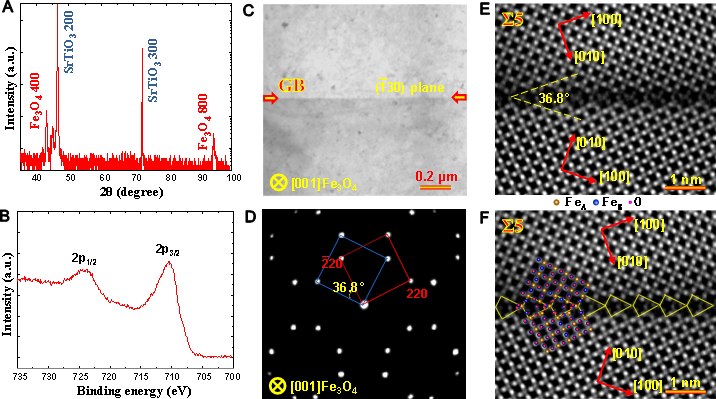
Structural characterization of the Fe₃O₄ Σ5 bicrystal thin film. (Image by IMR)
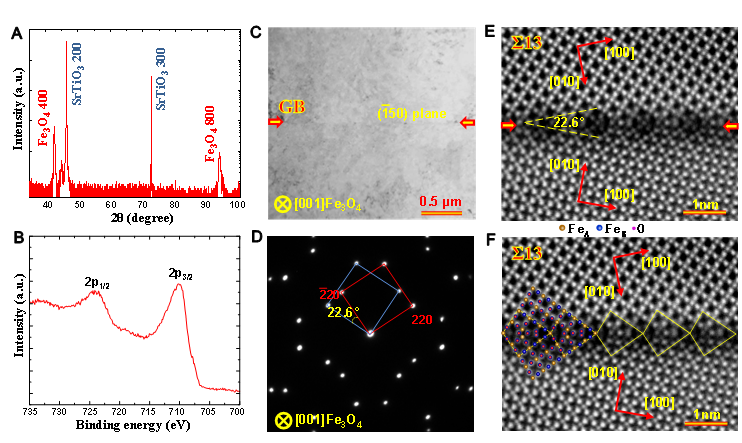
Structural characterization of theFe₃O₄ Σ13 bicrystal thin film. (Image by IMR)
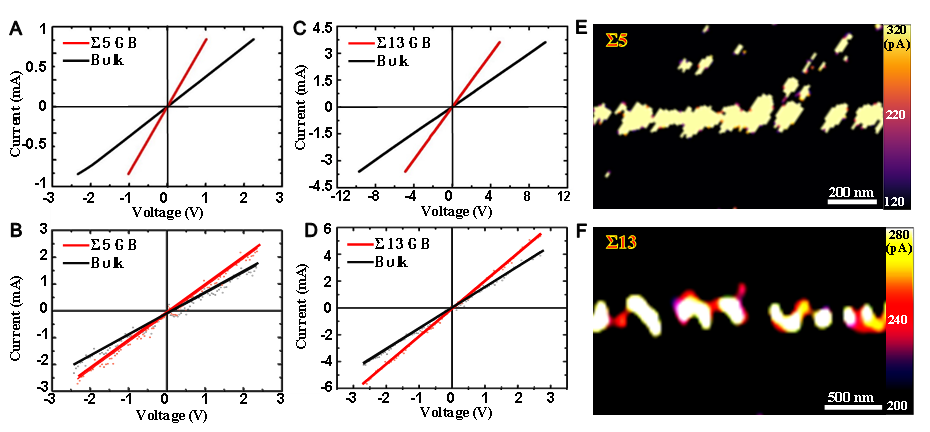
Conductivity measurements of the Fe₃O₄ bicrystal thin films. (Image by IMR)
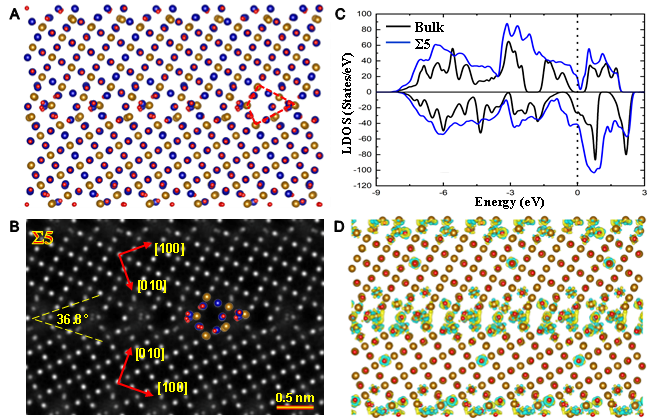
First‑principles calculations of the electronic structure of the Σ5 grain boundary. (Image by IMR)
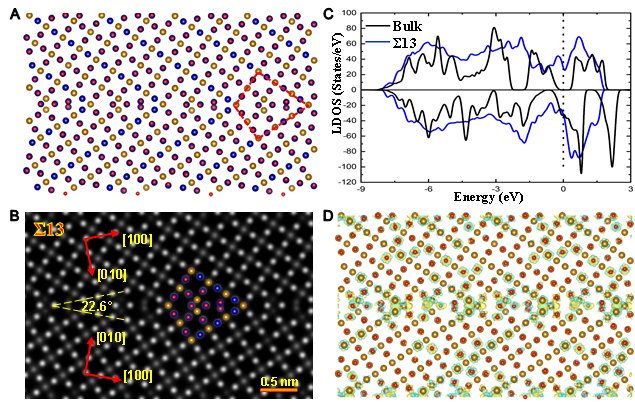
First‑principles calculations of the electronic structure of the Σ13 grain boundary. (Image by IMR)