Scientists from the Institute of Metal Research, Chinese Academy of Sciences (IMR, CAS), have developed a versatile compatibilizing-solvent plasticization strategy that resolves the long-standing incompatibility between electrochemically stable plasticizers and polymer matrices, paving the way for practical high-energy, high-safety solid-state lithium metal batteries.
Polymer electrolytes, particularly poly(vinylidene fluoride) (PVDF)-based systems, are promising for solid-state lithium metal batteries owing to their high oxidative stability and ionic conductivity. Conventional Plasticizers like dimethylformamide are crucial for facilitating ion transport. Yet, their inherent electrochemical instability causes them to continuously decompose at the electrode interfaces. Conversely, electrochemically stable plasticizers such as sulfolane are thermodynamically incompatible with PVDF, preventing the formation of homogeneous electrolyte films.
A research team led by Prof. LI Feng, Prof. SUN Zhenhua and Prof. CHENG Hui-ming has now broken this barrier by proposing a compatibilizing-solvent-enabled plasticization strategy. By introducing a volatile compatibilizing solvent, the team effectively lowered the Flory–Huggins interaction parameter of the mixed system, overcoming thermodynamic repulsion and yielding a homogeneous precursor solution. During membrane formation, the rapid evaporation of the compatibilizing solvent sharply increased the system viscosity, locking the plasticizer (sulfolane) within the three-dimensional polymer network and achieving uniform plasticization of otherwise immiscible components.
Molecular dynamics simulations and spectroscopic analyses further revealed that the PVDF-HFP copolymer interacts with sulfolane through atypical hydrogen bonding. This interaction not only restricts the free migration of the plasticizer, suppressing interfacial side reactions, but also reconstructs the solvation structure into an anion-aggregate-dominated configuration. Consequently, a stable LiF-rich interphase layer forms at both the anode and cathode interfaces, significantly enhancing electrode compatibility.
The resulting solid-state lithium metal batteries demonstrated exceptional performance. When paired with a 4.7 V high-nickel cathode, the battery cycled stably for 700 cycles at an ultrahigh rate of 20 C (3 min charge/discharge) with 81.9% capacity retention. An ampere-hour-scale pouch cell with a thin lithium anode (N/P ratio of 1.1) achieved stable cycling over 100 cycles and an impressive energy density of 451.5 Wh kg-¹ – far exceeding commercial lithium iron phosphate cells (about 200 Wh kg⁻¹). Moreover, the pouch cell passed nail penetration testing, demonstrating inherent safety.
This work, published in the Journal of the American Chemical Society, breaks the selectivity constraints of polymer–plasticizer combinations and expands the design space for polymer electrolytes, providing key technological support for the practical implementation of high-safety, high-energy solid-state lithium batteries.
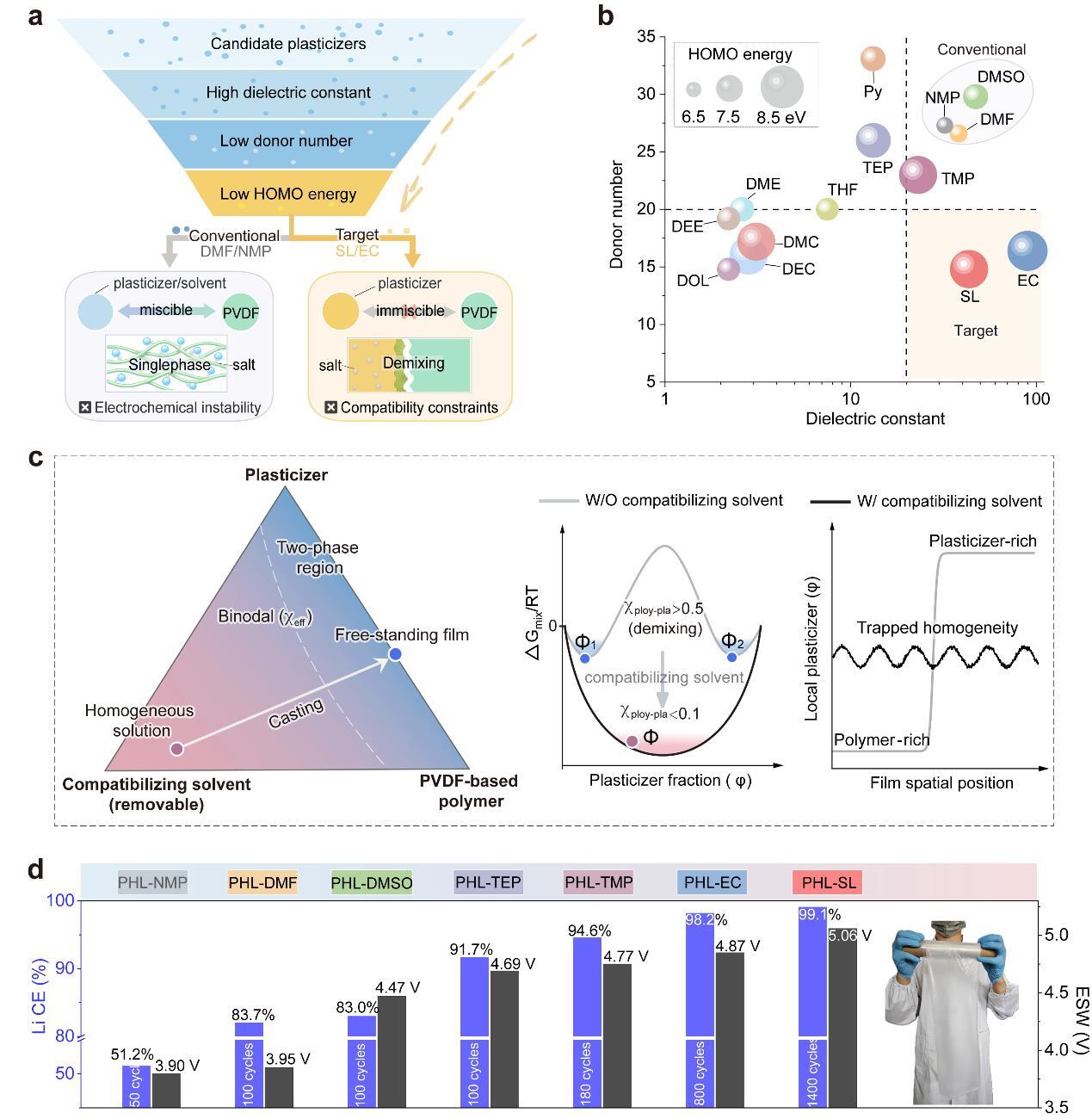
Compatibilizing-solvent plasticization strategy expands the polymer–plasticizer combination range. (Image by IMR)
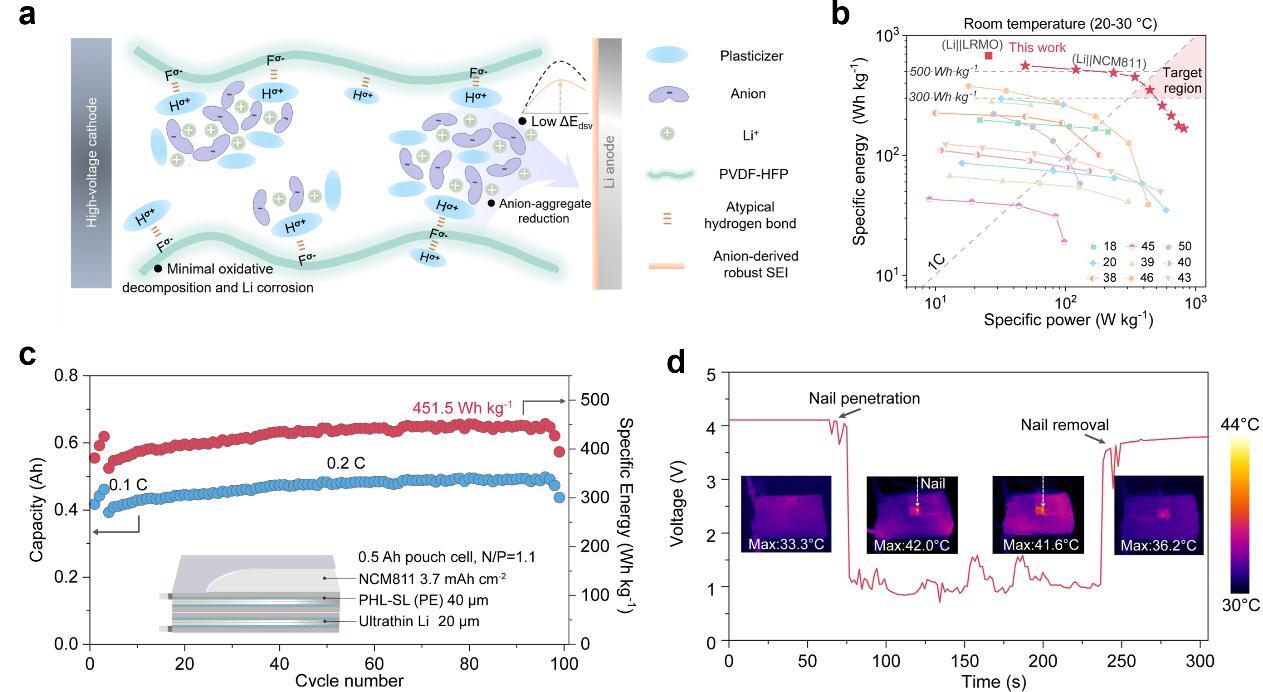
Polymer‑modulated anion‑aggregate solvation structure and solid‑state battery performance. (Image by IMR)