Scientists from the Institute of Metal Research, Chinese Academy of Sciences (IMR, CAS), have made a new discovery about the "light etching region" (LER), which is a typical microstructural degradation feature induced by rolling contact fatigue (RCF). This feature was previously believed to occur only in high-temperature aerospace bearing steels. Now they have found it also exists in AISI 52100 (GCr15) bearing steel, the most widely used bearing material worldwide. This finding overturns the long held assumption that LER formation is material-specific and reveals it as a universal degradation mode.
Rolling contact fatigue (RCF) is the primary failure mode of bearings. Under cyclic contact stresses, the subsurface microstructure of bearing steels progressively degrades, directly affecting the reliability and service life of critical equipment. Among various microstructural degradations, the LER was first identified in M50 and M50NiL steels designed for aerospace engine bearings operating at elevated temperatures. For a long time, researchers considered LER formation a unique attribute of those specific alloys. This assumption limited deeper investigation into its intrinsic formation mechanism.
Using multi-scale characterization, the IMR team systematically revealed the LER's hierarchical microstructure. At the optical scale, the LER appears as a region with lighter contrast relative to the surrounding matrix spanning 100–500 μm. Inside this region, a high density of low-angle grain boundaries forms worm-like dislocation walls with just tens of nanometers thickness. Under continued cyclic contact stresses, these walls evolve into isolated dislocation cells. More notably, the original carbides decompose within the LER and are replaced by a dense dispersion of nanoscale carbides (2–5 nm) that precipitated during RCF. This unique combination of high density low angle grain boundaries and nanoscale carbide precipitation raises the local microhardness by approximately 50% relative to the original martensitic matrix. It also greatly enhances acid resistance, explaining the region's bright appearance after conventional etching.
This work demonstrates that LER formation is driven by cyclic contact stress rather than compositional specificity, fundamentally redefining the understanding of RCF-induced degradation in bearing steels. The findings, published in Acta Materialia, provide a solid microstructural basis for improving bearing life prediction and developing more fatigue resistant materials across a wide range of industrial applications.
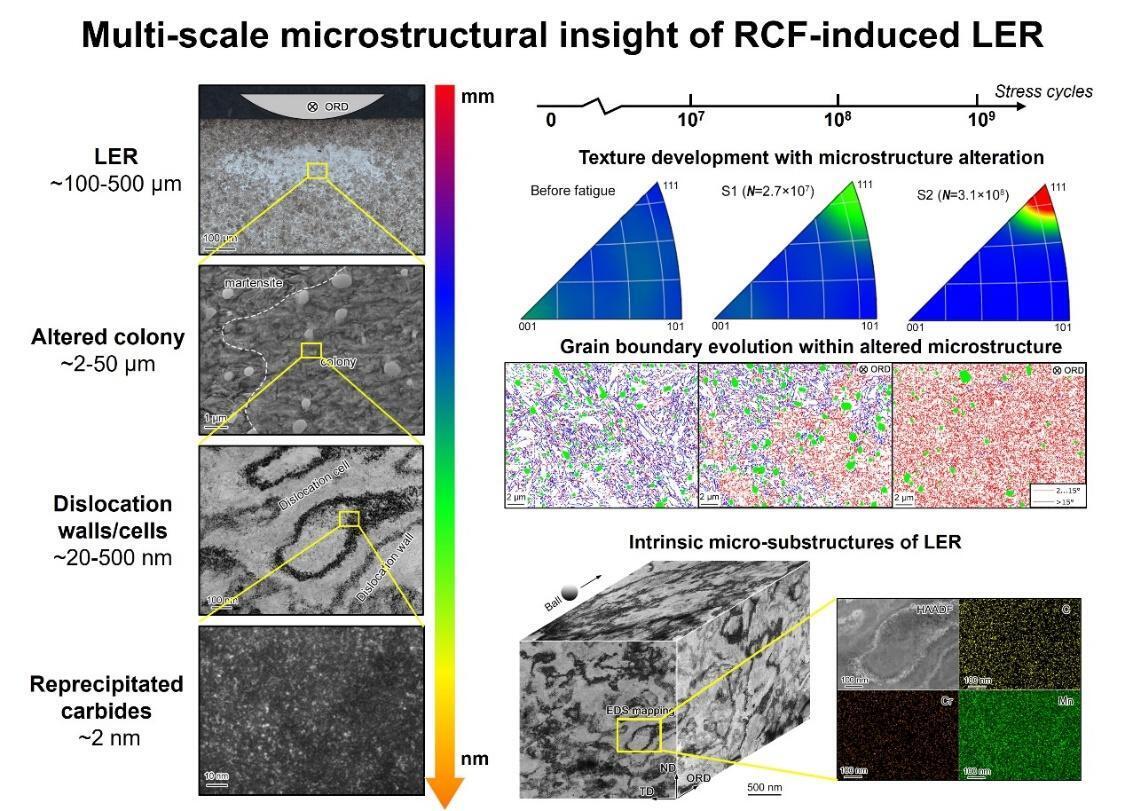
Multi-scale characteristics of the light etching region induced by rolling contact fatigue. (Image by IMR)
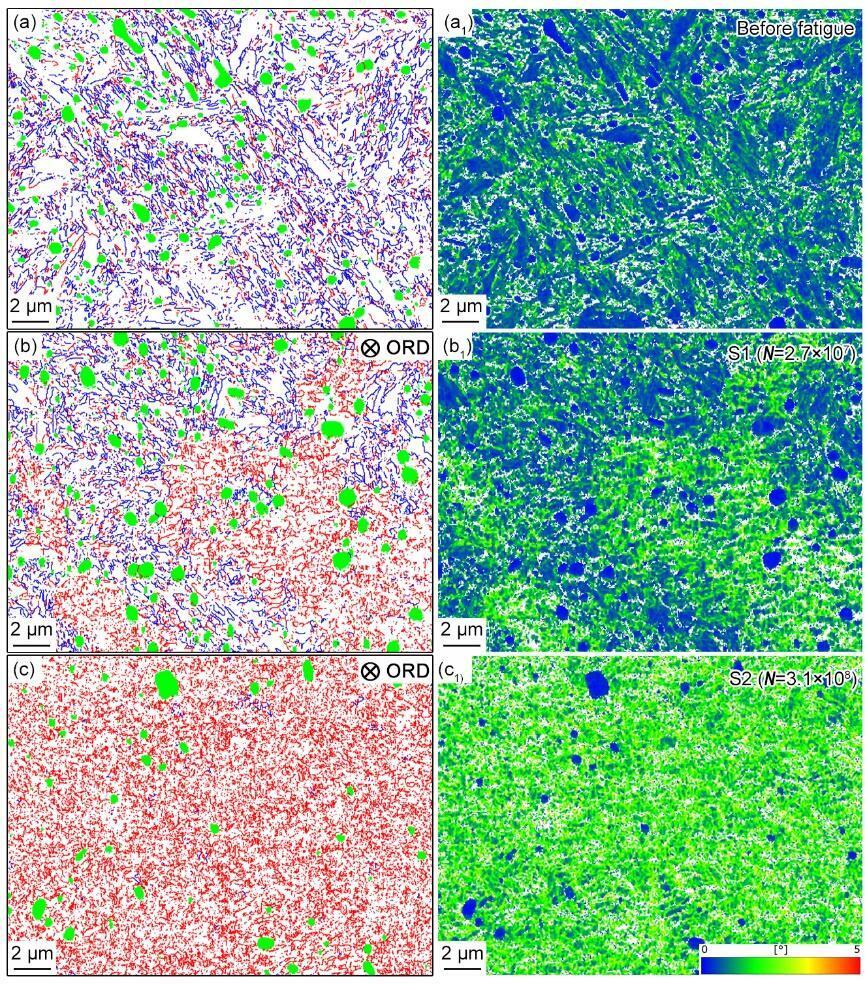
Evolution of grain boundary distribution and corresponding KAM distribution inside the light etching region. (Image by IMR)
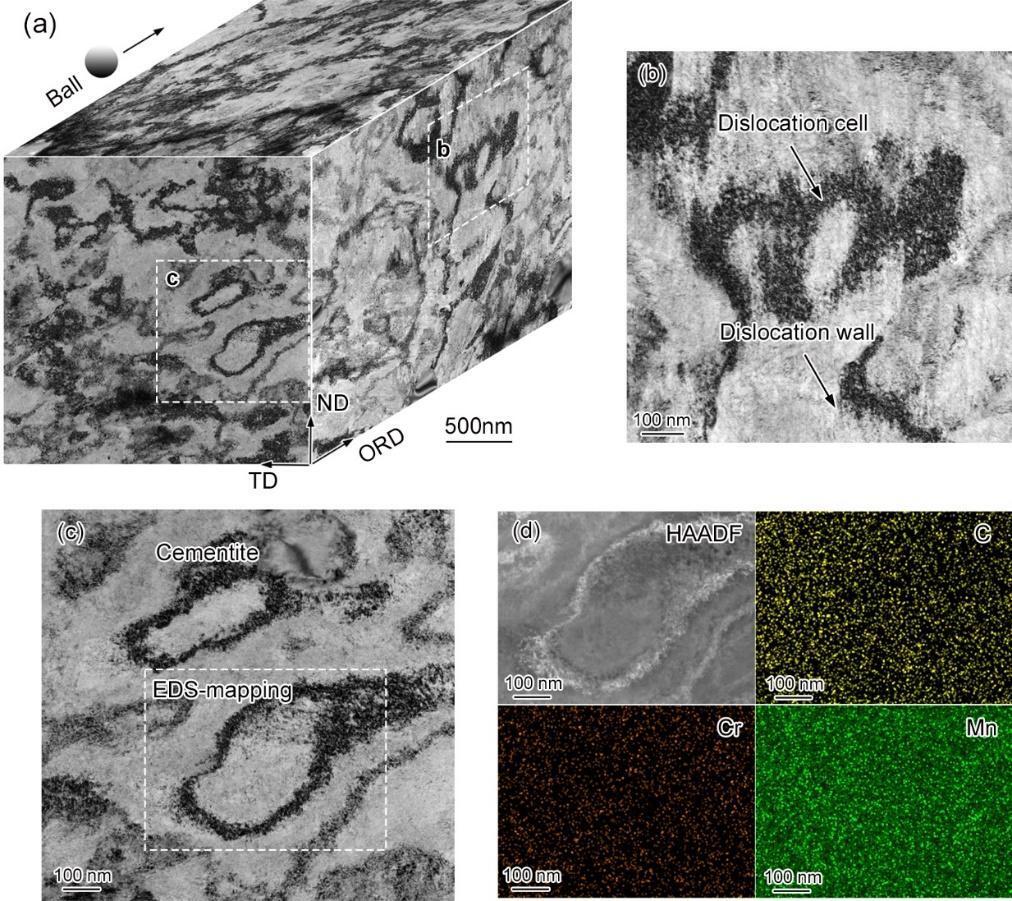
Intrinsic microstructure and alloying element distribution inside the light etching region. (Image by IMR)
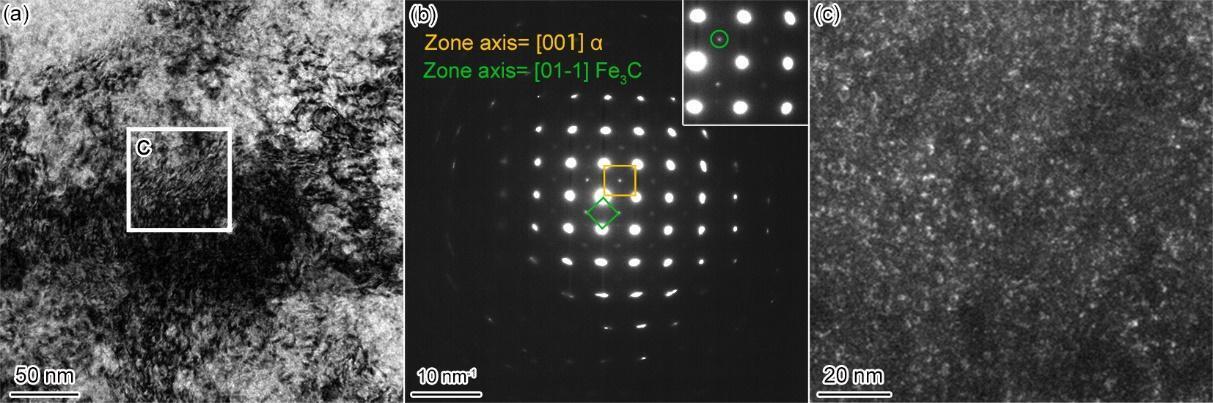
Dispersive precipitation of nanoscale carbides inside the light etching region. (Image by IMR)