Scientists from the Institute of Metal Research, Chinese Academy of Sciences (IMR, CAS), in collaboration with several research institutions, have developed a novel high-frequency silicon-graphene-germanium barristor that achieves record current gain and cut-off frequency, paving the way for transistors capable of operating in the terahertz (THz) range for future 6G and ultra-high-speed sensing systems.
The ever-increasing demand for faster wireless communication—from 5G deployment to next-generation 6G—requires transistors with cut-off frequencies exceeding 1 THz. Traditional high-frequency transistors, such as high-electron-mobility transistors (HEMTs) and heterojunction bipolar transistors (HBTs), are fundamentally limited by carrier transit times in the channel or base region. Vertical transistors based on two-dimensional materials like graphene offer a promising alternative: the atomically thin base drastically shortens vertical transit times. However, these devices have suffered from severe current gain limitations due to quantum tunneling barriers and interfacial defects that cause carrier scattering.
A research team led by Prof. SUN Dongming and Prof. LIU Chi from IMR has now overcome this long-standing challenge. They fabricated a silicon-graphene-germanium vertical heterostructure by first growing wafer-scale single-crystalline monolayer graphene on a germanium substrate using chemical vapor deposition, then precisely stacking a single-crystalline silicon film on top of the graphene. The resulting structure exploits asymmetric Schottky barriers at the graphene/silicon and graphene/germanium interfaces, combined with work-function modulation via graphene’s quantum capacitance effect. This design produces a much larger current variation on the germanium side than on the silicon side, yielding a common-emitter current gain as high as 1.8 × 10⁷—the highest ever reported for any transistor. In terms of high-frequency performance, the barristor achieves an intrinsic cut-off frequency (fT) of 132 GHz, surpassing all previously reported vertical graphene-base transistors. Device modeling and simulations further indicate that by optimizing doping concentrations, reducing contact resistance, and minimizing parasitic effects, the theoretical operating frequency could exceed 1 THz, entering the terahertz regime.
This work, not only establishes a solid foundation for barristors in radio-frequency and terahertz communications but also opens a new technological path for ultra-high-speed signal processing in future IoT and 6G sensing systems.
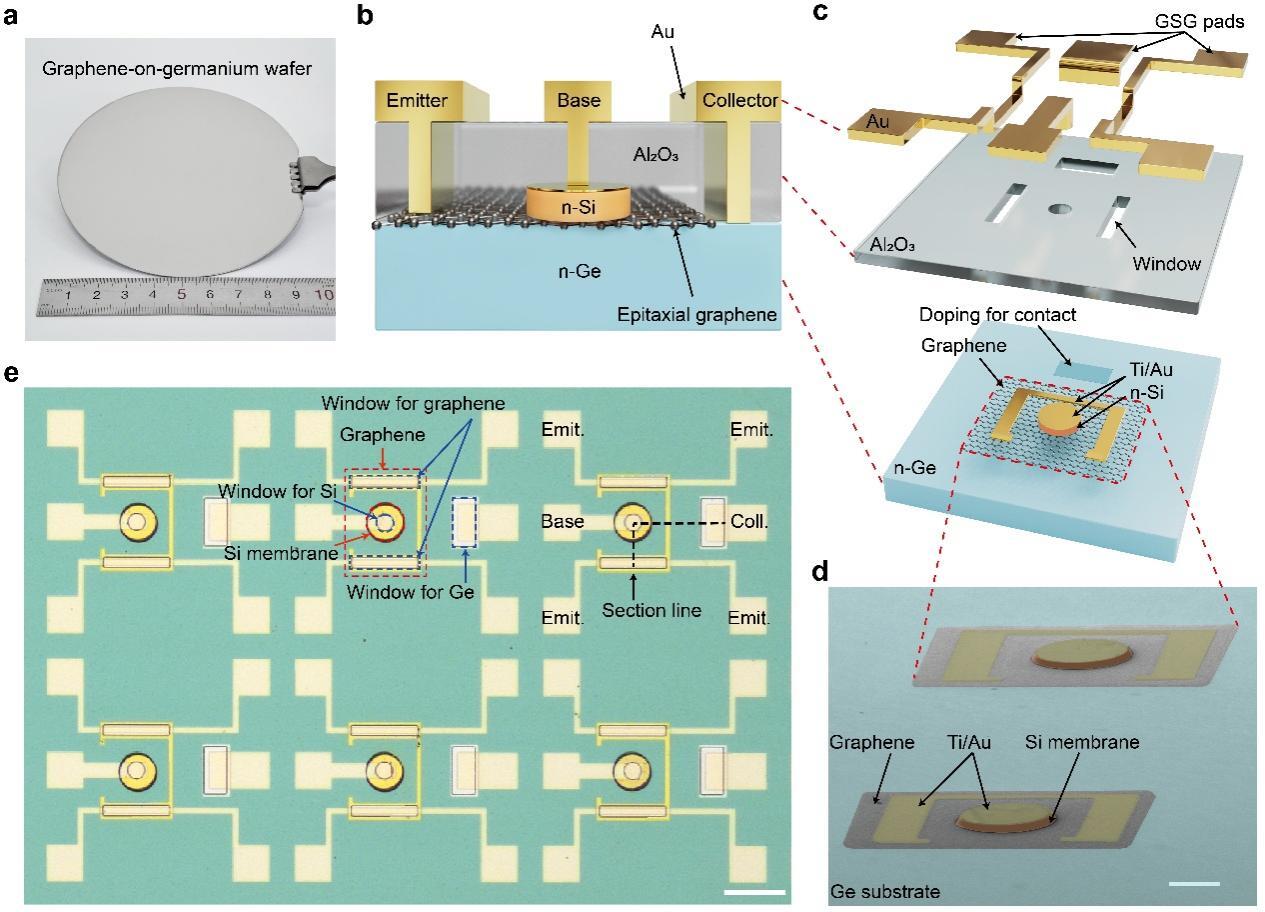
High-frequency silicon-graphene-germanium barristor device structure. a. Epitaxial graphene wafer; b. Cross-sectional schematic of the device; c. Exploded view of the device structure; d. Scanning electron microscopy image; e. Optical image of the device array. (Image by IMR)
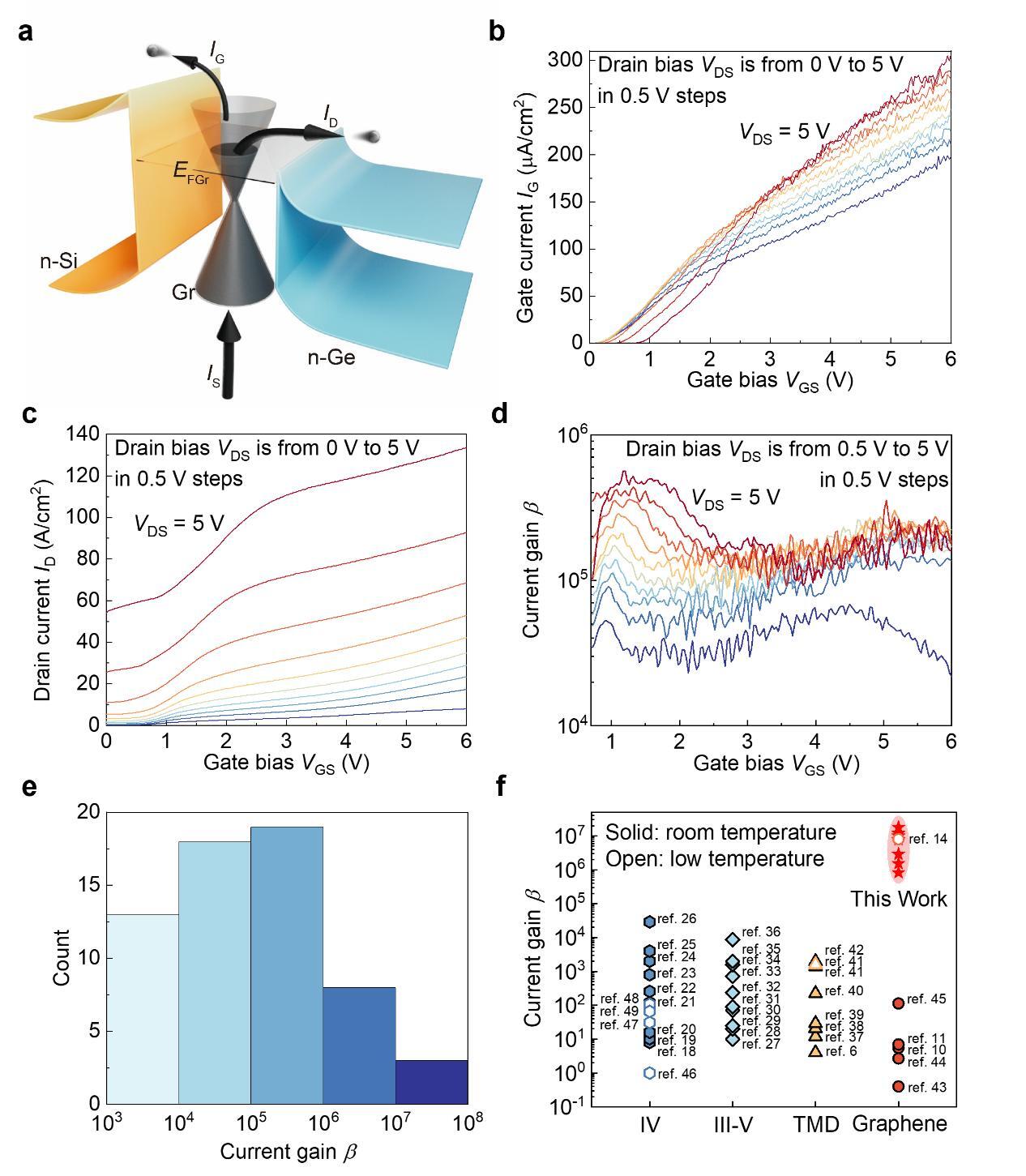
Mechanism and DC characteristics of the barristor. a. Energy band diagram of asymmetric Schottky barriers; b. Input characteristics of the device; c. Transfer characteristics of the device; d. Current gain as a function of gate voltage; e. Statistical analysis of device gain; f. Benchmarking of gain against transistors based on other material systems. (Image by IMR)
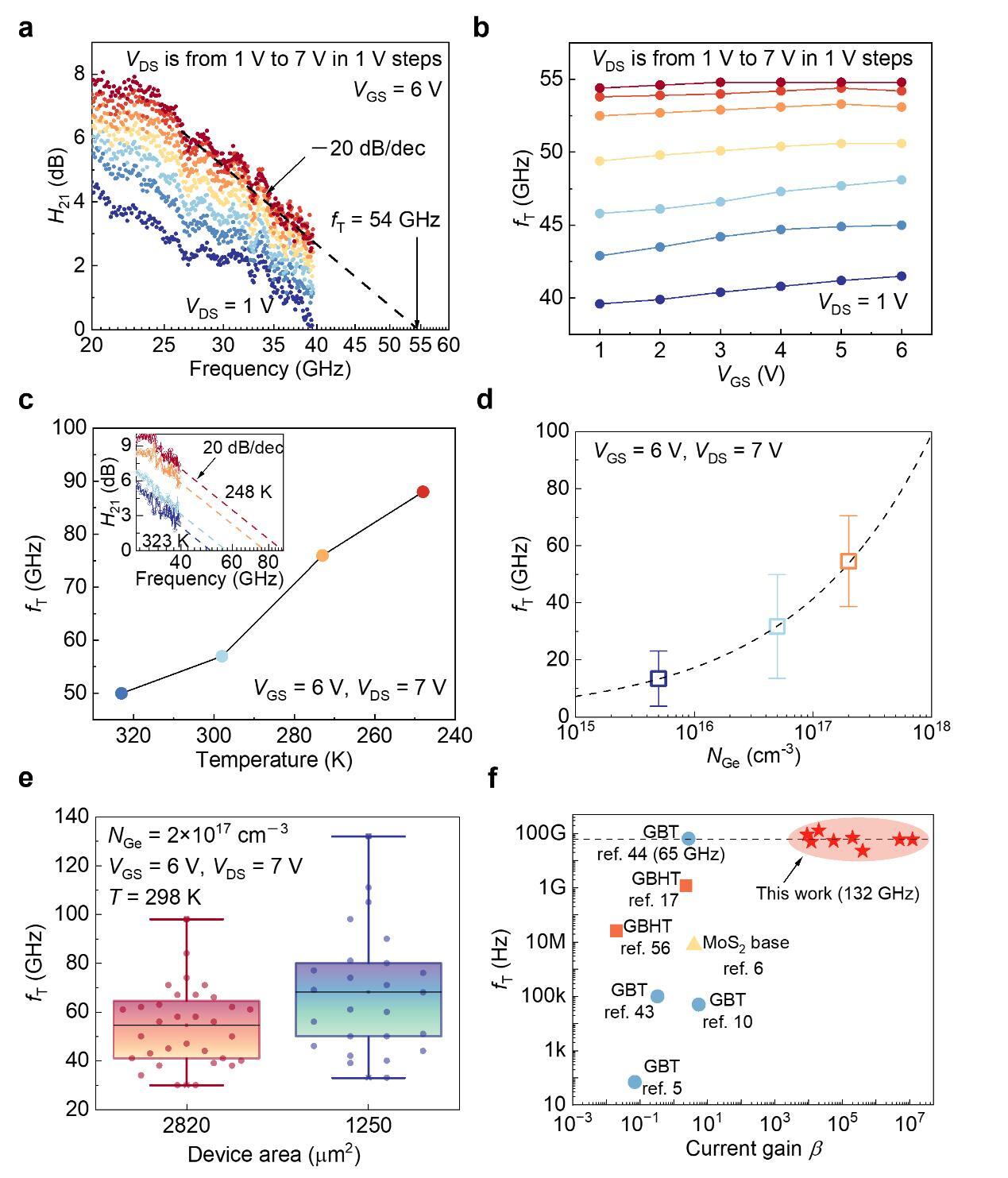
Radio-frequency characteristics of the barristor. a. Frequency dependence of gain H₂₁ under different bias voltages; b. Current gain cut-off frequency as a function of bias voltage; c. Temperature dependence of cut-off frequency; d. Distribution of cut-off frequency under different germanium doping concentrations; e. Statistics of cut-off frequency for devices with different areas; f. Benchmarking of radio-frequency performance against other vertical graphene-base transistors. (Image by IMR)
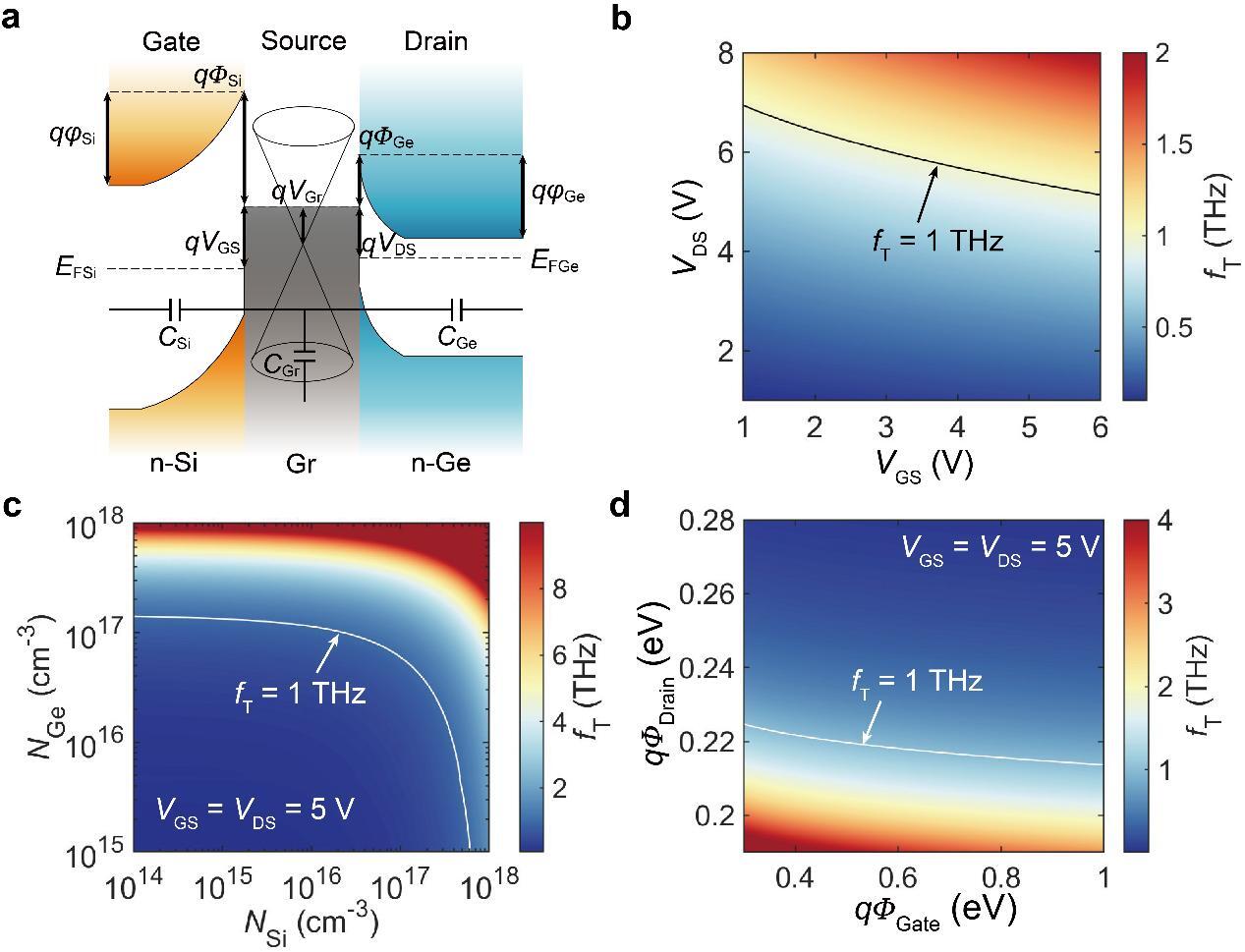
Compact physical model of the silicon-graphene-germanium barristor. a. Capacitance model and energy band diagram; b. Cut-off frequency as a function of bias voltage; c. Cut-off frequency as a function of doping concentration; d. Cut-off frequency as a function of Schottky barrier height. (Image by IMR)