A research team led by Prof. LIU Hongyang and Prof. DIAO Jiangyong at the Shenyang National Laboratory for Materials Science, Institute of Metal Research, Chinese Academy of Sciences (IMR, CAS), with collaborators, has successfully constructed a fully exposed platinum-palladium heteronuclear cluster catalyst on a defective graphene support (ND@G) for the efficient multi-step hydrogenation of dinitrotoluene (DNT). The results were published in Angew. Chem. Int. Ed.
Toluene diisocyanate (TDI) is a key raw material for polyurethane synthesis, with the global TDI market reaching $5 billion in 2025 and a projected compound annual growth rate of 5.3%. The multi-step hydrogenation of DNT to diaminotoluene (DAT) is a critical step in TDI production. However, conventional noble metal nanoparticle catalysts used in this process suffer from high loading, large particle sizes, and low atom utilization efficiency, resulting in prohibitively high catalyst costs that constrain the sustainable development of China's TDI industry.
Previous work by the team revealed that electron-rich fully exposed Pt clusters experience electrostatic repulsion with electron-rich nitro groups, weakening substrate adsorption and limiting catalytic performance. Conversely, electron-deficient Pt single atoms exhibit strong adsorption toward nitro groups. To overcome this bottleneck, the team introduced adjacent Pd single atoms to modify the fully exposed Pt clusters, leveraging heteronuclear metal synergy to optimize substrate adsorption and the electronic structure of active centers. The resulting fully exposed PtPd cluster consists of Pt clusters (averaging 4 Pt atoms) bonded to neighboring Pd single atoms, as confirmed by AC-HAADF-STEM and XAFS characterization.
Structural characterization and density functional theory calculations revealed that the adjacent Pd single atom serves as an additional adsorption site for the nitro group of DNT, inducing a unique bidentate adsorption configuration between the Pt cluster and the Pd site that achieves optimal adsorption strength. Concurrently, charge transfer from Pd to Pt elevates the charge density of the Pt clusters, facilitating H2 dissociation. As a result, the Pt4Pd1/ND@G catalyst exhibits exceptional hydrogenation activity in the multi-step hydrogenation of DNT, achieving a remarkable turnover frequency of 64,109 h^-1, substantially surpassing the performance of Pt clusters, Pd single atoms, and state-of-the-art catalysts reported in the literature.
This work provides a strategic guideline for designing fully exposed cluster catalysts and offers valuable insights into atomic-level manipulation of catalytic sites for multi-step hydrogenation reactions. It deepens the understanding of synergistic catalysis in fully exposed bimetallic clusters and paves the way for developing low-cost, high-efficiency catalysts for industrial hydrogenation processes.
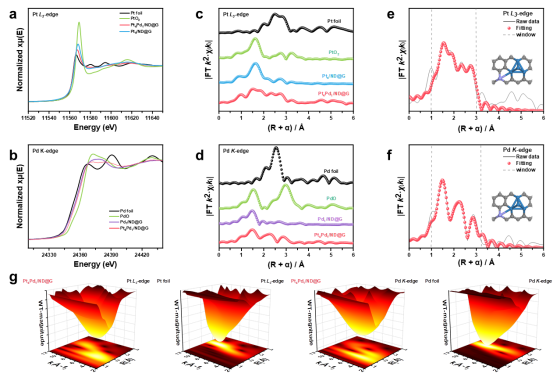
Catalyst characterization by synchrotron XAFS: (a-b) Pt L₃-edge and Pd K-edge XANES spectra of Pt₄Pd₁/ND@G, (c-d) Pt L₃-edge and Pd K-edge EXAFS spectra of Pt₄Pd₁/ND@G, (e-f) EXAFS fitting results of Pt₄Pd₁/ND@G at Pt L₃-edge and Pd K-edge, (g) wavelet transforms of Pt₄Pd₁/ND@G, Pt foil, and Pd foil. (Image by IMR)
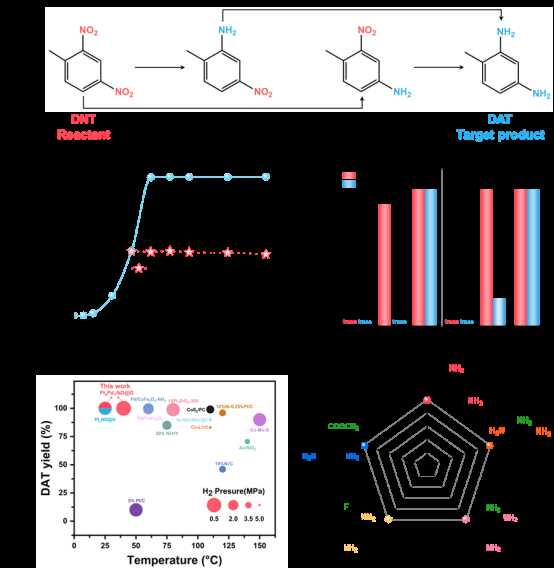
Evaluation of DNT hydrogenation performance: (a) reaction pathway of DNT multi-step hydrogenation, (b) DAT yield versus time curves and hot-filtration test of Pt₄Pd₁/ND@G, (c) comparison of hydrogenation performance among Pt₄Pd₁/ND@G, Pt₄/ND@G, and Pd₁/ND@G, (d) comparison with literature-reported catalysts for DNT hydrogenation, (e) substrate extension experiments. (Image by IMR)
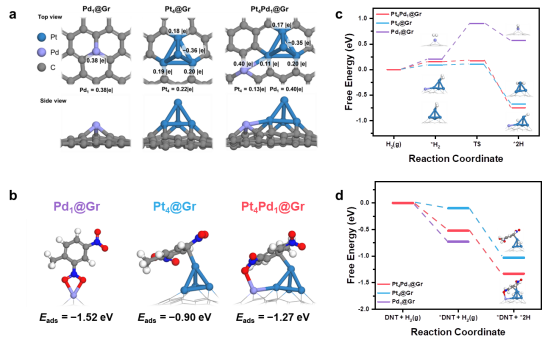
DFT calculations: (a) theoretical models and Bader charge analysis of Pt₄Pd₁@Gr, Pt₄@Gr, and Pd₁@Gr, (b) optimal adsorption configurations and corresponding adsorption energies of DNT on Pt₄Pd₁@Gr, Pt₄@Gr, and Pd₁@Gr, (c) Gibbs free energies for H₂ dissociation on Pt₄Pd₁@Gr, Pt₄@Gr, and Pd₁@Gr, (d) Gibbs free energies for H₂ dissociation after DNT adsorption on Pt₄Pd₁@Gr, Pt₄@Gr, and Pd₁@Gr. (Image by IMR)
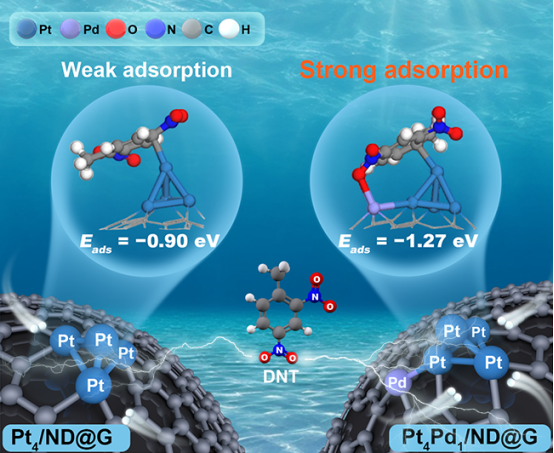
Schematic illustration of the multi-step hydrogenation of dinitrotoluene catalyzed by fully exposed PtPd clusters. (Image by IMR)