Scientists from the Institute of Metal Research, Chinese Academy of Sciences (IMR, CAS) in collaboration with research partners, have developed a rare earth doping strategy that fundamentally suppresses photocorrosion in Aurivillius‑phase photocatalysts, offering a new pathway toward stable and efficient solar‑to‑hydrogen conversion.
Semiconductor photocatalysis, which directly converts solar energy into hydrogen fuel, represents a key technological route for producing “green hydrogen” and is critical for achieving carbon neutrality. However, many highly active photocatalysts, including CdS, BiVO₄ and Aurivillius‑phase compounds, suffer from severe photocorrosion during water splitting—structural degradation and rapid loss of activity that have become a major bottleneck for practical application.
Conventional approaches to mitigating photocorrosion, such as loading cocatalysts, constructing heterojunctions, or optimizing reaction conditions, aim to facilitate charge transfer and reduce surface charge accumulation. While effective to some degree, these methods do not alter the material's intrinsic thermodynamic tendency toward photocorrosion.
The research team, inspired by the classical “cathodic protection” principle from metal corrosion engineering—which uses potential regulation to suppress corrosion—proposed a strategy to control the surface self‑reduction potential of photocatalysts through rare earth (RE) doping. Using the photocorrosion‑prone Aurivillius‑phase compound Bi₃TiNbO₉ as a model system, the team combined density functional theory calculations with experimental validation to systematically elucidate the mechanism by which rare earth doping suppresses photocorrosion.
The study revealed that the introduction of rare earth elements forms stronger RE—O bonds at the material surface compared to Bi—O bonds, effectively shifting the surface self‑reduction potential to a level lower than the water reduction potential. Under this new thermodynamic landscape, photogenerated electrons preferentially drive water reduction for hydrogen production rather than attacking the material itself, fundamentally suppressing photocorrosion at its source.
Importantly, this strategy is not limited to Bi₃TiNbO₉. The researchers demonstrated that the rare earth doping approach can be extended to a range of Aurivillius‑phase compounds, including SrBi₂Nb₂O₉, Bi₄Ti₃O₁₂ and SrBi₄Ti₄O₁₅, showing good universality. Experimental validation with Ce‑doped Bi₃TiNbO₉ confirmed significantly enhanced photochemical stability, with theoretical predictions closely matching experimental results.
This work, published in Advanced Functional Materials, successfully transfers the well‑established potential‑regulation concept from metal corrosion protection to the design of stable semiconductor photocatalysts, opening a new avenue for solving the photocorrosion problem in high‑activity photocatalytic materials.
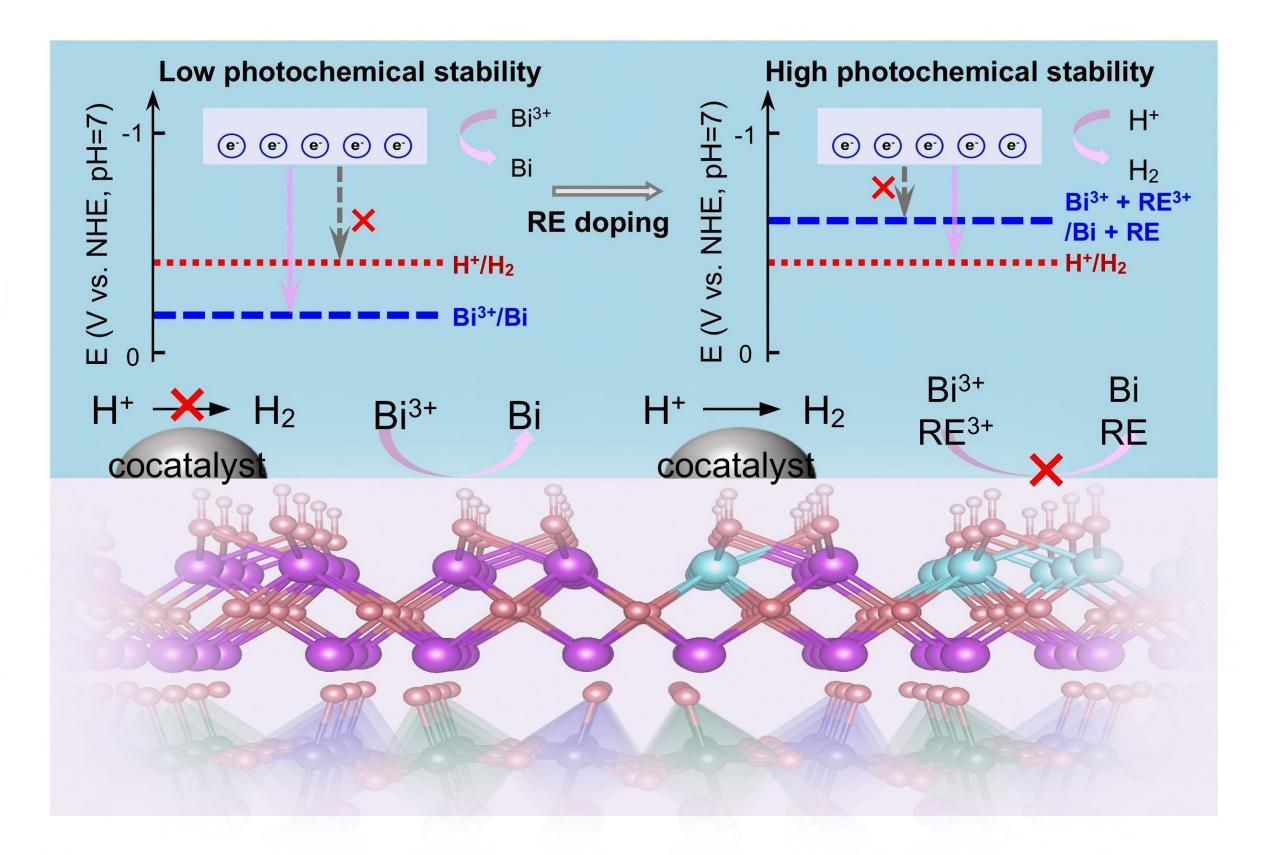
Schematic illustration of the mechanism for improving the photochemical stability of Aurivillius-phase compounds via rare earth doping. (Image by IMR)