Prof. ZHANG Zhidong from the Institute of Metal Research, Chinese Academy of Sciences (IMR, CAS), has achieved a significant breakthrough in the study of the Riemann hypothesis, one of the most fundamental and long-standing unsolved problems in mathematics. The results, published in Physics Letters A, demonstrate that the generalized Riemann hypothesis—including the original Riemann hypothesis—holds true by establishing a rigorous equivalence between the zero distributions of the Riemann zeta function and a competing two-dimensional Ising model.
First formulated by Bernhard Riemann in 1859, the Riemann hypothesis posits that all non-trivial zeros of the Riemann zeta function lie on the critical line where the real part of the complex variable equals 1/2. Its generalization to Dirichlet L-functions is known as the generalized Riemann hypothesis. Despite over 160 years of effort—including massive computer searches verifying billions of zeros on the critical line, partial proofs that certain fractions of zeros lie on the line, and zero-density estimates—a complete proof has remained elusive. The difficulty lies in the fundamental gap between finite numerical verification and infinite logical proof, as well as the local nature of existing number-theoretic tools.
A promising direction has been to connect the Riemann zeta function to physical systems, an approach rooted in the Hilbert–Pólya conjecture, which proposes that the non-trivial zeros of the Dirichlet L-functions correspond to the eigenvalues of a self-adjoint operator. In 1972, Montgomery discovered that the statistical distribution of the zeros on the critical line matches the pair correlation of random Hermitian matrices from the Gaussian unitary ensemble (GUE), a connection later reinforced by Dyson and Berry. However, the key challenge has been to construct a physical model whose partition function zeros are equivalent to those of the Dirichlet L-functions and whose energy eigenvalues are all real.
Prof. ZHANG Zhidong constructed a two-dimensional Ising model with ferromagnetic interactions along one crystallographic direction and randomly distributed competing ferromagnetic/antiferromagnetic interactions along the other. He proved that all energy eigenvalues of this model are real and randomly distributed, analogous to the Möbius function, the Dirichlet L-function, and the Riemann zeta function. The eigenvectors of the model are constructed from those of the one-dimensional Ising model with phases related to the Riemann zeta function, forming the Hilbert–Pólya space. Using the Onsager–Kaufman exact solution of the two-dimensional Ising model, he demonstrated that the Hamiltonian is self-adjoint and the system belongs to the Gaussian unitary ensemble. By applying the Lee–Yang unit circle theorem and Fisher zero analysis, he proved that all zeros of the partition function lie on a unit circle in the complex temperature plane, which is then mapped uniquely to the critical line. This mapping establishes the closure of the non-trivial zero distribution of the Dirichlet L-function (including the Riemann zeta function), thereby proving the generalized Riemann hypothesis.
This work bridges statistical physics, random matrix theory, and number theory, providing a physical analogy that resolves a centuries-old mathematical conjecture. It paves the way for deeper understanding and further refinement of the generalized Riemann hypothesis.
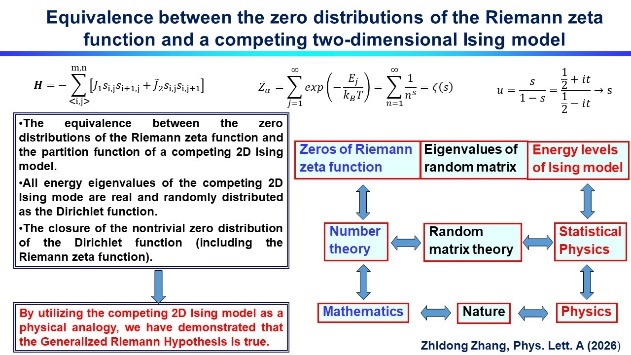
Equivalence between the zero distributions of the Riemann zeta function and a competing two-dimensional Ising model (Image by IMR)