A research team led by Prof. TANG Yunlong at the Shenyang National Laboratory for Materials Science, Institute of Metal Research, Chinese Academy of Sciences (IMR, CAS), has discovered an anomalous over-strain-relaxation mechanism that enables the construction of polar vortex arrays in ferroelectric superlattices grown on nominally compressive substrates. The findings, published in Advanced Materials, challenge the long-held view that periodic polar topologies rely exclusively on tensile strain engineering.
Polar topological structures in ferroelectric materials—such as vortices, flux-closure domains, and skyrmions—hold promise for low-power, high-density information storage. However, ferroelectric films grown on compressively strained substrates, such as PbTiO₃, typically develop purely out-of-plane polarization. How to induce and manipulate polar topologies under compressive strain has remained an open question.
The team chose the classic PbTiO₃/SrTiO₃ superlattice system on NdGaO₃ (NGO) substrates, which exhibits a nominal lattice mismatch of approximately –1.0% at room temperature. Using high-resolution X-ray diffraction reciprocal space mapping and atomic-scale transmission electron microscopy, they identified periodic a⟨100⟩ misfit dislocation arrays at the NGO–superlattice interface with a spacing of about 23 nanometers—considerably shorter than the theoretically predicted 39 nanometers.
This anomalously high dislocation density arises from a synergistic interplay between thermal mismatch dynamics and the ferroelectric–paraelectric phase transition. At the growth temperature of 720°C, the lattice parameter of PbTiO₃ changes abruptly due to thermal expansion and the phase transition near the Curie temperature, increasing the nominal mismatch from –1.0% at room temperature to approximately –2.3%. This larger mismatch drives the formation of a higher density of interfacial dislocations, which "over-relax" the compressive strain. Upon cooling to room temperature, the 23 nm-spaced dislocation array locks the superlattice into an equivalent tensile strain state of about +0.7%.
Atomic-scale polarization analysis and phase-field simulations further revealed that the local strain fields introduced by interfacial dislocations significantly influence the polarization arrangement in the bottom PbTiO₃ layers, driving a transition from polar vortices to periodic dipole waves.
This work demonstrates that polar topologies can be constructed and controlled on nominally compressive substrates through a previously unknown over-strain-relaxation state. It elucidates a new strain engineering paradigm driven by the synergy of thermal expansion and ferroelectric phase transition. More importantly, it shows that dislocations—traditionally considered detrimental crystal defects—can serve as effective tools for tailoring polar topological states.
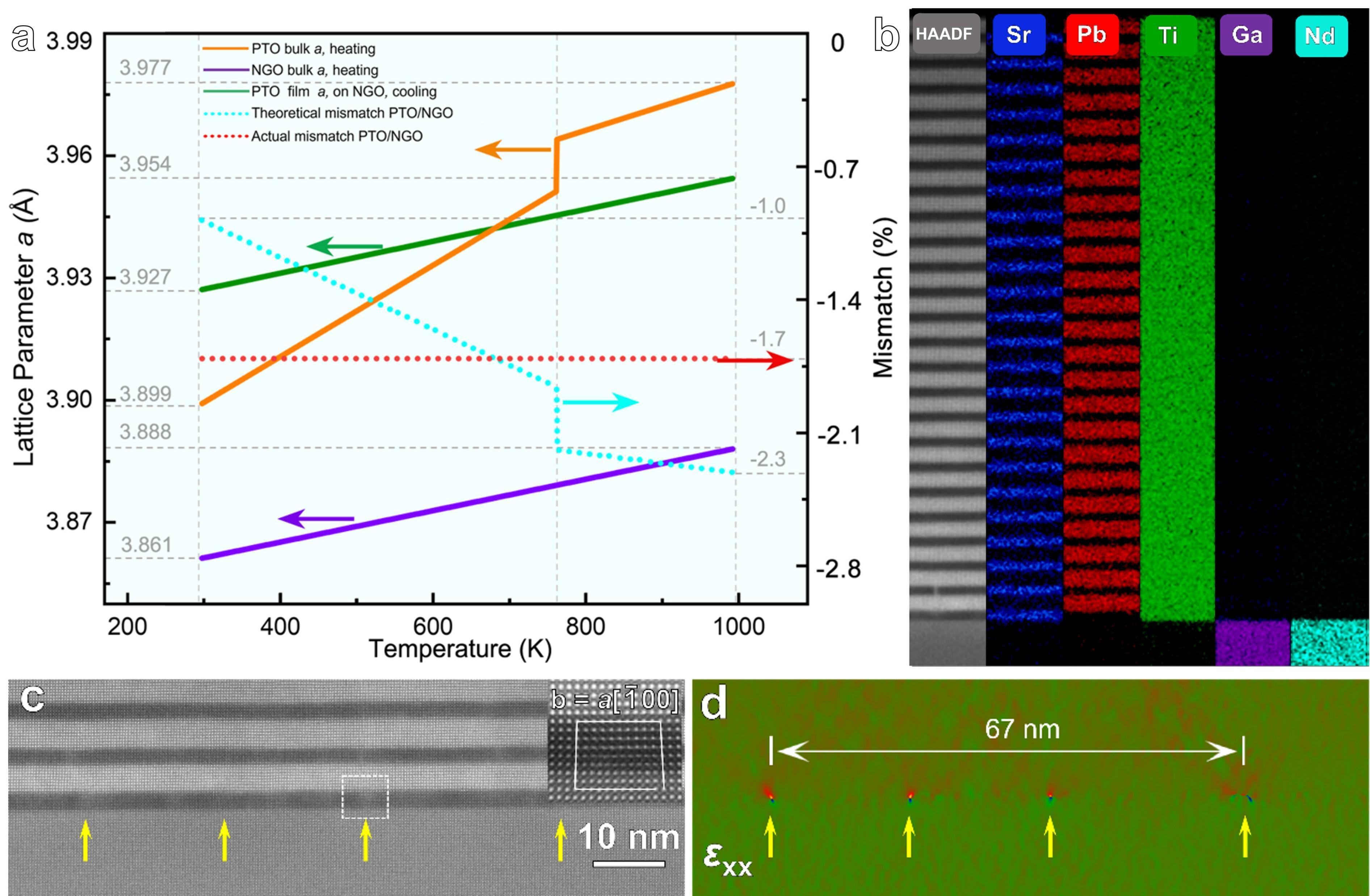
Calculated in-plane lattice parameters and mismatch variations of the epitaxial films based on linear thermal expansion theory, together with high-spatial-resolution energy-dispersive spectroscopy elemental maps, showing the high-quality periodic PTO/STO superlattice structure grown on the NGO substrate. (Image by IMR)
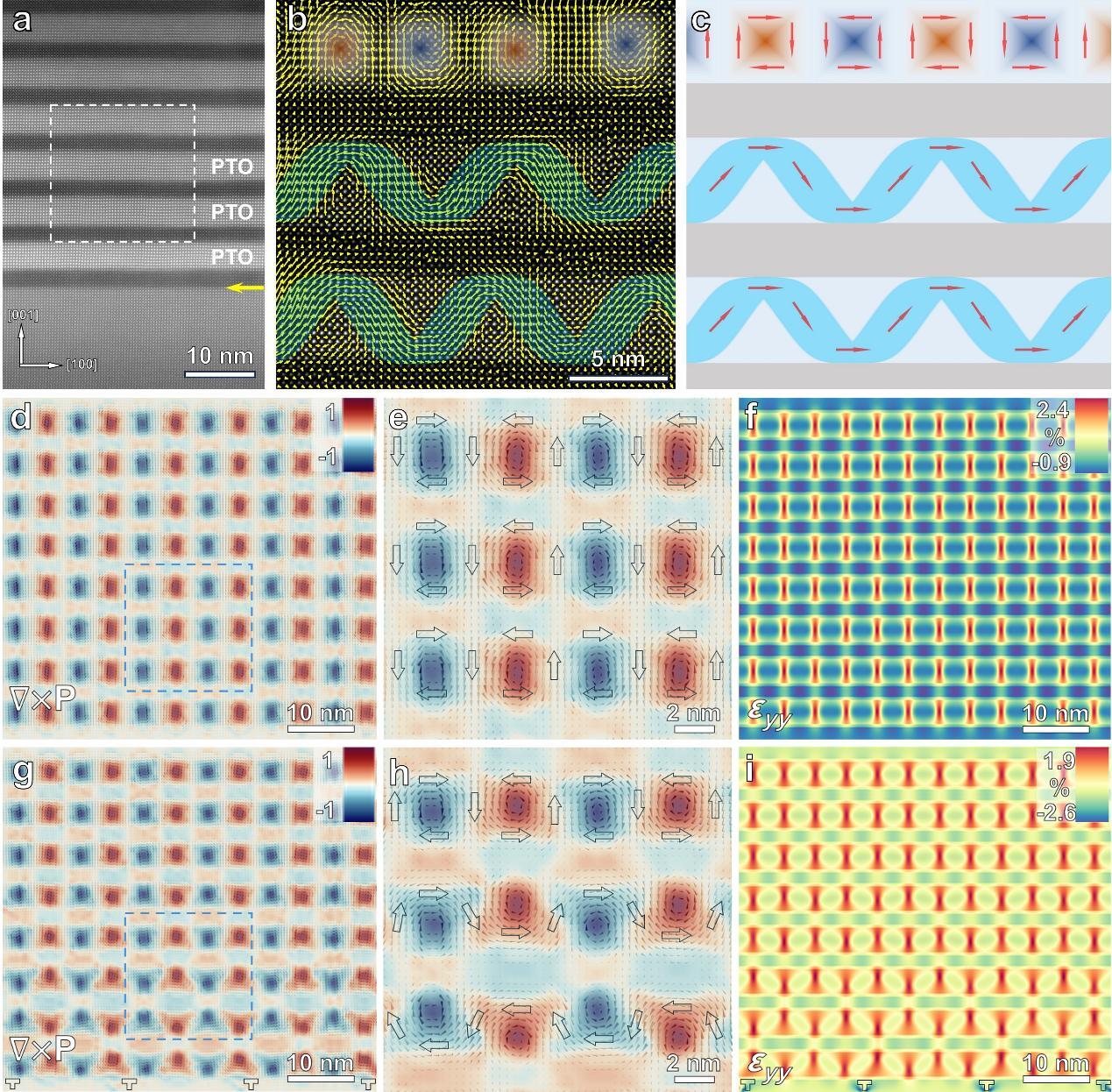
Atomic-scale polarization vector analysis and phase-field simulations, revealing the polar vortex arrays and the dislocation-induced vortex-to-dipole-wave transition. (Image by IMR)