A research team led by Prof. LI Bing from the Shenyang National Laboratory for Materials Science, Institute of Metal Research, Chinese Academy of Sciences (IMR, CAS), has been invited to publish a comprehensive review on colossal barocaloric materials in the Annual Review of Materials Research. The paper, titled "Colossal Barocaloric Materials", systematically summarizes progress in physical mechanisms, material discovery, and engineering exploration since the effect was first identified, while also outlining future directions.
Conventional vapor-compression refrigeration technology faces growing concerns over carbon emissions and energy consumption. Solid-state refrigeration based on phase-change materials is widely regarded as one of the most promising next-generation green cooling solutions. In 2019, the team made a landmark discovery by identifying and naming the "colossal barocaloric effect" in plastic crystals, achieving an order-of-magnitude leap in material performance and breaking the long-standing bottlenecks of excessively high driving pressures and modest isothermal entropy changes in solid-state refrigerants.
The review provides a comprehensive and systematic survey of colossal barocaloric materials discovered since 2019, covering not only classical organic plastic crystals but also inorganic plastic crystals, organic–inorganic hybrid perovskites, superionic conductors, spin-crossover compounds, metal–organic frameworks, and charge-transfer solids. It offers an in-depth analysis of six key performance metrics—entropy change, transition temperature, driving pressure, thermal hysteresis, thermal conductivity, and adiabatic temperature change—and elucidates their intrinsic trade-offs.
Regarding the origins of entropy change, the review identifies two mechanisms based on the fundamental Boltzmann relation: order–disorder mechanisms involving multiple internal degrees of freedom (orientational, occupational, magnetic, dipolar, charge, and conformational disorders), and phonon renormalization in the absence of disorder. The intrinsic trade-offs are particularly striking: colossal entropy change arises from strong disorder, yet phonon scattering by that same disorder leads to extremely low thermal conductivity; high latent heat of transition can be diluted by the material's large heat capacity, limiting the actual adiabatic temperature change; and low driving pressure often requires low modulus, which naturally reduces sound velocity and further degrades thermal conductivity.
Looking ahead, the review emphasizes the need to combine intrinsic and extrinsic strategies to overcome these trade-offs and achieve comprehensive performance enhancement. Particular attention should be paid to thermal–pressure fatigue, addressed through unique microstructural design to mitigate performance degradation over millions of pressure cycles in real-world applications. The paper highlights the importance of in situ characterization at large-scale facilities such as neutron scattering sources, as well as machine learning to accelerate new material discovery. It also stresses that accelerating the development of engineering prototypes is critically important for the future of barocaloric cooling technology.
The Annual Review series holds an exceptional reputation in the international academic community, operating under a strict invitation-only policy that extends writing invitations exclusively to scientists who have made pioneering contributions in their respective fields. Each journal publishes only one volume per year, and its review articles serve not only as summaries of past research but also as bellwethers charting future directions. Over the more than 50 years since the founding of Annual Review of Materials Research, fewer than 20 papers have been published with Chinese research institutions as the primary affiliation.
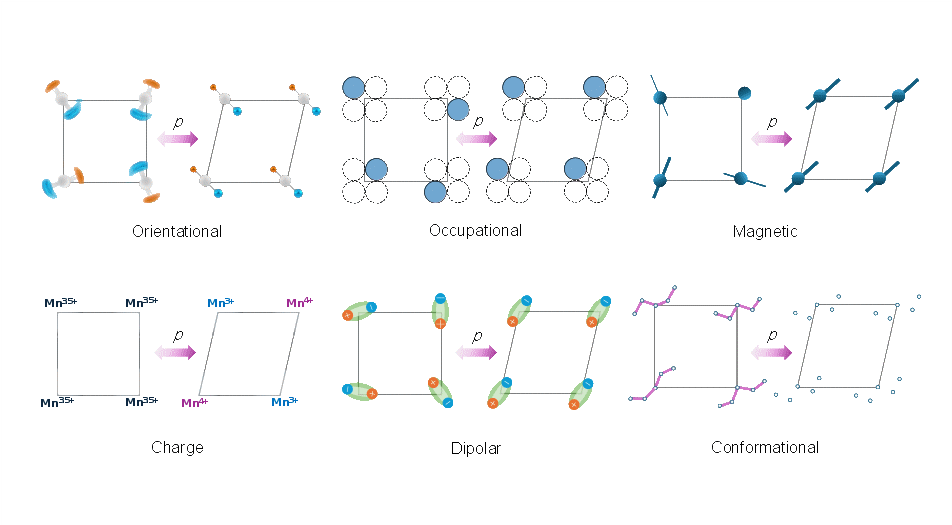
Schematic illustration of pressure-induced phase transition in colossal barocaloric materials. The transition is characterized by lattice symmetry breaking and involves multiple degrees of freedom, including molecular orientation, atomic occupancy, magnetic moments, dipoles, charge, and molecular conformation. (Image by IMR)