A research team from the Institute of Metal Research, Chinese Academy of Sciences (IMR, CAS), has successfully developed a multifunctional testing platform for barocaloric materials, filling a critical gap in standardized characterization tools for this emerging class of solid-state refrigerants. The device enables precise measurement of adiabatic temperature changes under pressure, accelerating the screening and optimization of high-performance cooling materials for environmentally friendly refrigeration technologies.
The phase-down of hydrofluorocarbon refrigerants under the Kigali Amendment and China's carbon neutrality goals have intensified the search for green cooling alternatives. The discovery of the colossal barocaloric effect in 2019 marked a milestone, achieving a leap in solid-state refrigeration performance and sparking global research interest. However, the lack of standardized characterization methods has become a bottleneck. Researchers have often relied on high-pressure differential scanning calorimetry to estimate adiabatic temperature changes indirectly—a method prone to significant errors and unable to faithfully replicate the physical behavior of materials under real cooling cycles.
The IMR team, led by Prof. LI Bing has overcome these limitations through an independently designed and built apparatus. The core unit integrates a high-pressure generation system capable of reaching 400 MPa, a modified Paris-Edinburgh pressure cell, and a precision temperature control and data acquisition system. With servo-hydraulic pump control, pressure fluctuations are stabilized within 0.1 MPa, and rapid unloading can be completed in less than 2 seconds—creating near-ideal adiabatic conditions for observing intrinsic temperature changes. The innovative cell design and millisecond-response thermocouples capture subtle transient temperature variations with a resolution of 0.1 K, significantly enhancing both accuracy and reliability.
The team calibrated the system using sodium chloride as a reference standard. The measured pressure-temperature curves closely matched theoretical predictions from the equation of state. COMSOL multiphysics simulations confirmed that the unloading time is much shorter than the sample's thermal recovery time, validating the device's adiabatic testing capability. The platform has demonstrated excellent performance in measuring adiabatic temperature changes for a range of typical materials, including organic and inorganic plastic crystals and metals. Programmed control further enabled over 100 loading-unloading fatigue cycles, revealing performance degradation patterns and verifying the beneficial effects of graphene compositing on material stability—providing critical data for engineering lifetime predictions.
This versatile testing platform provides a powerful scientific tool for probing the microscopic mechanisms of barocaloric effects and is expected to significantly accelerate the development of practical solid-state refrigeration technologies.
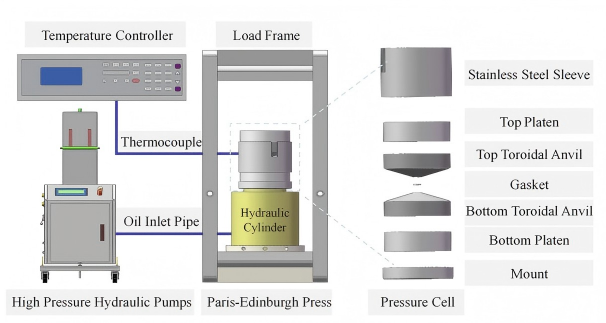
Schematic diagram of the instrument configuration. (Image by IMR)
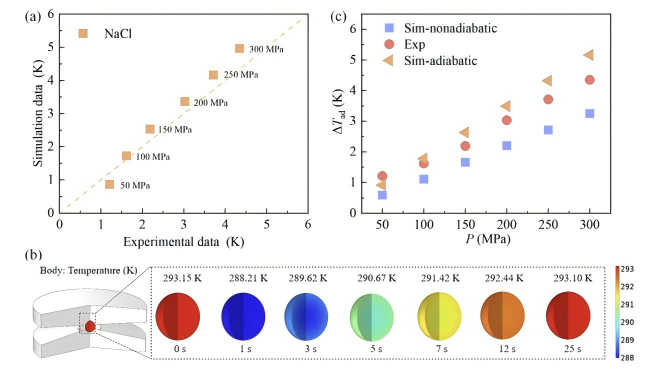
Calibration data of the instrument using NaCl. (Image by IMR)