A research team from the Institute of Metal Research, Chinese Academy of Sciences (IMR, CAS), has developed an electrochemical additive manufacturing technology that integrates gradient porous copper wick structures into Ω-shaped heat pipes, doubling the heat dissipation capacity compared to conventional grooved pipes. This breakthrough addresses a critical bottleneck in cooling high-performance chips for AI, big data and cloud computing.
As computing power in GPUs and TPUs grows exponentially, chip power consumption and heat flux density have surged, making thermal management a key constraint on performance and reliability. Oxygen-free copper heat pipes, which leverage phase-change heat transfer, are currently the mainstream solution. However, conventional trapezoidal or rectangular micro-grooved heat pipes are approaching their performance limits. Ω-shaped grooved heat pipes, with thermal conductivity up to 1,000 times that of pure copper, promise to be the next-generation solution—but integrating gradient porous copper wick structures with Ω grooves has remained a global manufacturing challenge.
The team, led by researchers from the Division of Materials Shape and Property Control in collaboration with the Scientific-Practical Materials Research Centre of the National Academy of Sciences of Belarus and Jiangxi Naile Copper Industry Co., has now overcome this hurdle. Their electrochemical additive manufacturing (ECAM) technique grows porous copper wick structures in situ on Ω-channel surfaces at high efficiency. By precisely controlling current and deposition time, copper ions are built up atom by atom from a copper salt solution, enabling controllable gradient pore sizes ranging from nanometers to micrometers.
The resulting electrochemically additive-manufactured gradient wick delivers twice the capillary force of conventional sintered copper powder wicks. Ω-channel heat pipes incorporating this gradient wick structure achieve double the single-pipe heat dissipation power of traditional grooved pipes.
This breakthrough solves the long-standing challenge of integrating gradient wick structures with Ω-channel heat pipes, providing critical material support for next-generation high-thermal-conductivity copper heat pipes in AI computing centers.
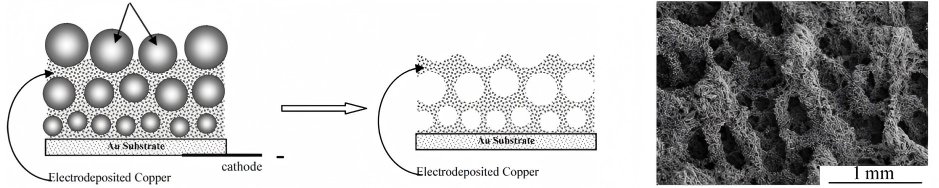
Proposed electrochemical additive manufacturing method for gradient porous copper structures. (Image by IMR)
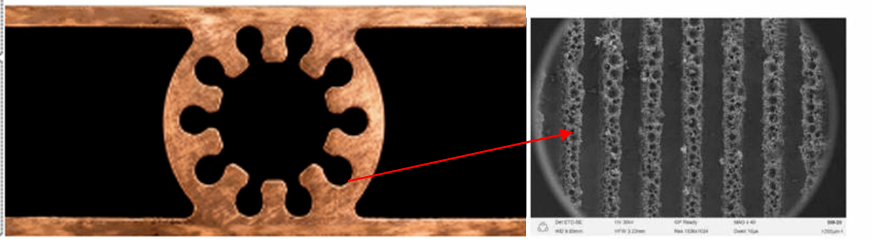
Integrated manufacturing of Ω‑grooved tubes and gradient wick structures. (Image by IMR)