A research team from the Institute of Metal Research, Chinese Academy of Sciences (IMR, CAS) and collaborators, has discovered a "bonding relay" mechanism that enables room-temperature dislocation glide in oxide crystals such as SrTiO₃ and MgO. This finding, published in Acta Materialia recently, challenges the long-held paradigm that oxides are intrinsically brittle, opening a new pathway for engineering flexible and mechanically resilient oxide materials for next-generation electronics and sensors.
Oxides have traditionally been regarded as inherently brittle due to their strong and stable ionic or covalent bonds, which stand in stark contrast to the ductile behavior of metals. In metals, delocalized electron sharing provides multi-centered bonding flexibility that enables rapid bond reorganization during deformation. Oxides, however, lack such "glue-like" electron delocalization. Conventional understanding held that when dislocations move in ionically bonded crystals, old bonds break and new bonds cannot reform in time, leading to bond network rupture, stress concentration, and ultimately catastrophic failure.
Through an integrated approach combining ab initio calculations, large-scale molecular dynamics simulations, and experimental nanoindentation, the team identified a universal structural criterion that enables room-temperature oxide plasticity: the presence of alternating positively and negatively charged atomic layers along specific slip directions, specifically the (110)[110] orientation in perovskite and rocksalt oxides. This charge-alternating configuration enables a "bonding relay" mechanism, in which sequential bond breaking and reformation across the slip plane, accompanied by interlayer persistent bonds, mimics the multi-centered interactions found in metals. This mechanism allows dislocation motion without catastrophic failure, enabling oxide crystals to exhibit metal-like plasticity at room temperature.
The team's calculations further reveal that while the dislocation glide barriers in these oxides are comparable to those in common face-centered cubic metals, the critical shear stress required for dislocation nucleation is substantially higher. This suggests that the primary bottleneck for oxide plasticity lies not in the difficulty of dislocation glide, but in the nucleation of dislocations themselves. Once a sufficient density of dislocations is present—for example, through nanoindentation or pre-existing defects—the glide process becomes energetically favorable, enabling plastic deformation similar to that of metals.
Beyond SrTiO₃ and MgO, the same mechanism was verified in SrO and SrₓPb₁₋ₓTiO₃ solid solutions, confirming that the "charge-alternating layer" criterion is a general structural principle applicable to a broad range of ionic crystals. This work provides a new theoretical foundation for designing ductile oxide materials and challenges the absolute notion that "ceramics equal brittleness."
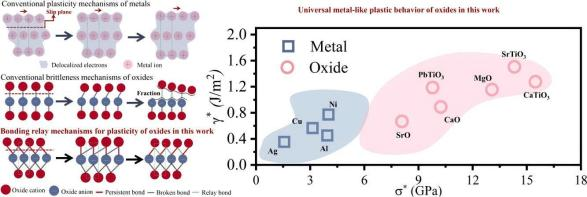
Schematic diagram of bonding characteristics and slip deformation in metal and oxide crystals (left); two-dimensional distribution map of slip energy barrier (lattice resistance) γ* and critical shear stress σ for metal and oxide crystalline materials (right). (Image by IMR)
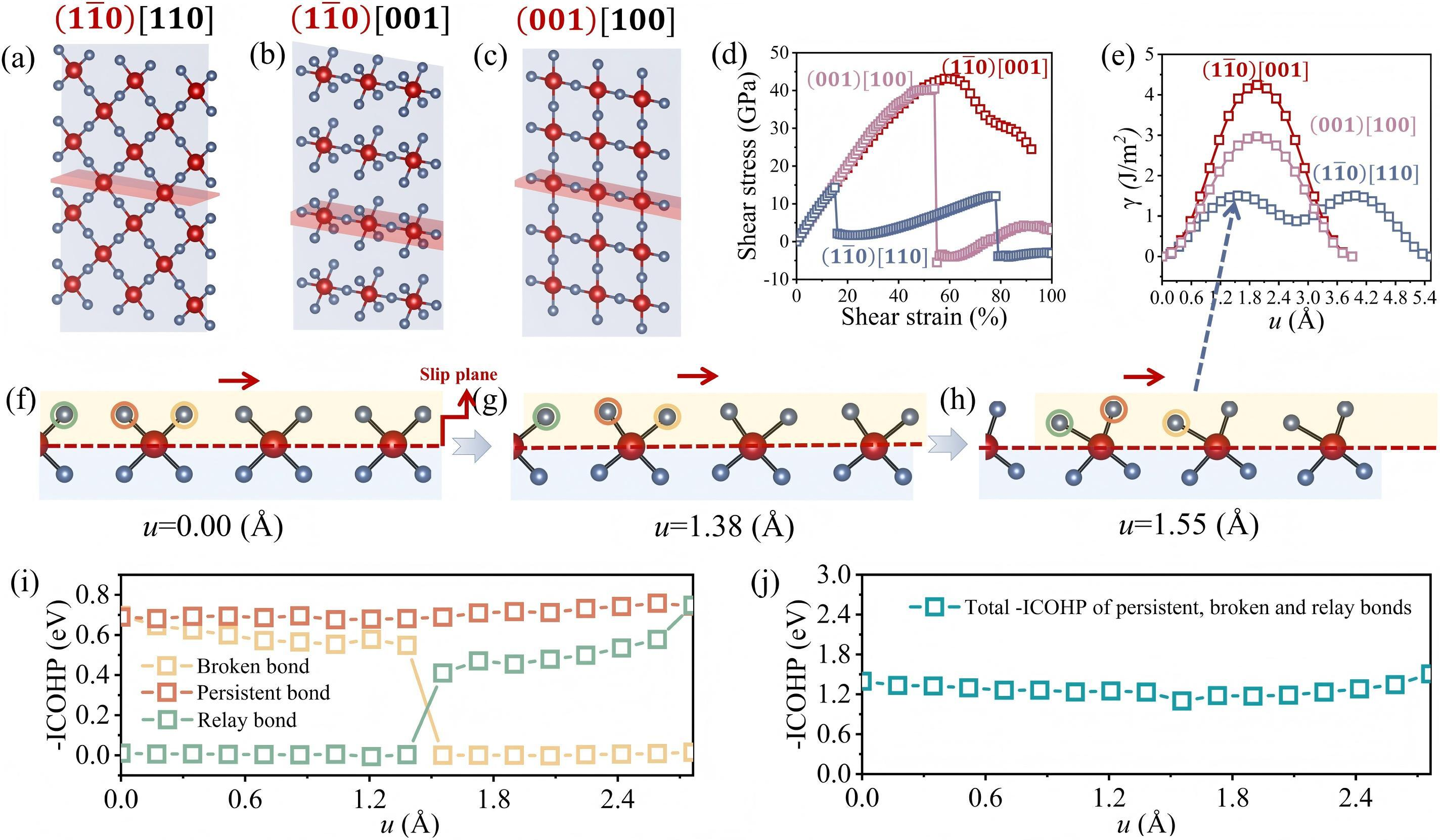
Plastic deformation model and calculations for shear along the [110] direction in SrTiO₃. (a)–(c) Atomic geometries of the Ti–O sublattice in SrTiO₃ under three crystallographic orientations (three slip systems): (a) [110], (b) [001], (c) (001)[100]. Large and small spheres represent Ti and O atoms, respectively. (d) Shear stress–strain curves for each orientation, and (e) slip energy barriers for each orientation calculated by DFT. (f)–(h) Atomic configurations at different displacement u values during shear deformation along the [110] direction on the slip plane. (i) Evolution of –ICOHP values for persistent bonds, broken bonds, and relay Ti–O bonds during slip. Oxygen atoms involved in key Ti–O interactions are indicated by circles in (f)–(h). (j) Sum of –ICOHP values for the three types of bonds, showing the overall conservation of bonding strength throughout the “bonding relay” process. (Image by IMR)
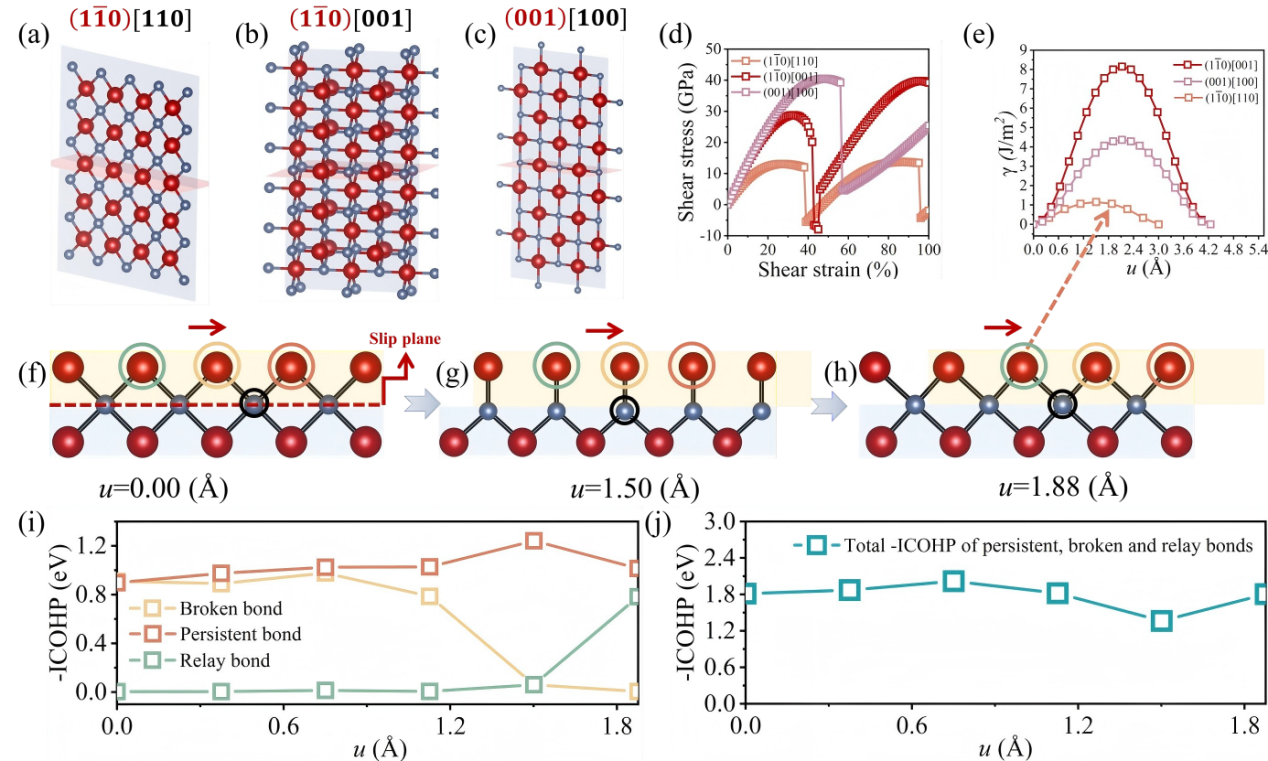
Schematic illustration and calculation process of plastic deformation for shear along the [110] direction in MgO crystals. (Image by IMR)