A research team from the Institute of Metal Research, Chinese Academy of Sciences (IMR, CAS), in collaboration with partners, has revealed a new mechanism by which spatially ordered heteroatoms induce bulk polarization in nonpolar semiconductor photocatalysts, offering a promising pathway to overcome the long-standing challenge of efficient charge separation for solar water splitting.
Solar water splitting, often regarded as the "holy grail" of artificial photosynthesis, aims to directly convert solar energy into hydrogen fuel using semiconductor photocatalysts. In nonpolar semiconductors, however, photogenerated electrons and holes recombine rapidly within the bulk, severely limiting efficiency. Introducing a built-in electric field that penetrates the entire particle, which provides a strong driving force for charge separation, is considered an ideal strategy to suppress bulk recombination.
Inspired by polar semiconductors such as piezoelectric and ferroelectric materials, the team reasoned that if non-centrosymmetric atomic arrangements could be achieved in nonpolar semiconductor particles, bulk polarization could be induced, creating a built-in electric field throughout the particle. While heteroatom doping is known to induce local lattice polarization, at low doping concentrations heteroatoms are typically randomly distributed, resulting in randomly oriented local polarizations that cancel out at the macroscopic scale.
Using interstitial Li-doped TiO2 as a model system, the team combined density functional theory calculations with machine learning to reveal a "spatial ordering" mechanism driven by "local symmetry reduction → orbital hybridization → electron localization." Specifically, the intrinsic local symmetry of interstitial Li forbids hybridization between its s orbital and neighboring Ti-d orbitals. However, introducing additional interstitial Li at specific sites reduces this local symmetry, enabling the previously forbidden orbital hybridization to occur and forming new Li-s/Ti-d hybridized states. The excess electrons introduced by interstitial Li then occupy these hybridized states, lowering the system energy and making this specific spatially ordered doping configuration thermodynamically most favorable. Further introduction of N3- for charge compensation suppresses recombination centers while maintaining the spatial ordering of Li/N heteroatoms.
Theoretical calculations predicted bulk polarization intensities of 2.36 and 3.47 μC/cm2 along the [100] and [001] directions, respectively, for Li/N co-doped TiO2 at 5 at.% doping concentration. Moreover, the team successfully synthesized the predicted material, and structural characterization and performance tests confirmed the theoretical predictions.
Importantly, this mechanism is not unique to TiO2. The team generalized it to two narrow-bandgap nonpolar visible-light responsive photocatalysts: Y2Ti2O5S2 and SrTaO2N, demonstrating its potential generalizability to other nonpolar semiconductor functional materials.
This work, published in Advanced Materials, provides a new strategy for promoting bulk charge separation in nonpolar semiconductors, with broad implications for photocatalytic energy conversion.
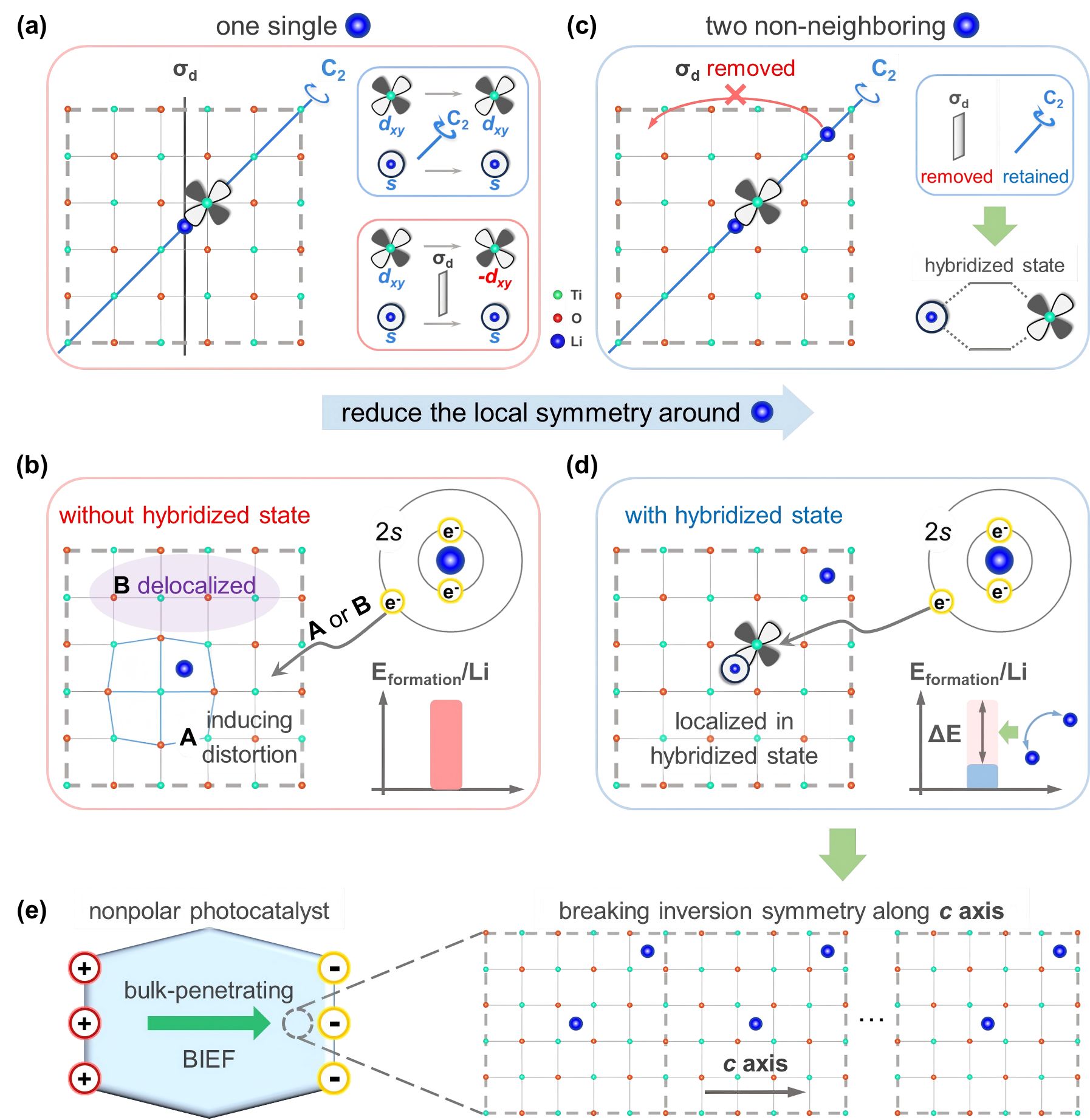
Schematic illustration of bulk polarization induced by an ordered spatial distribution of interstitial dopants. (Image by IMR)
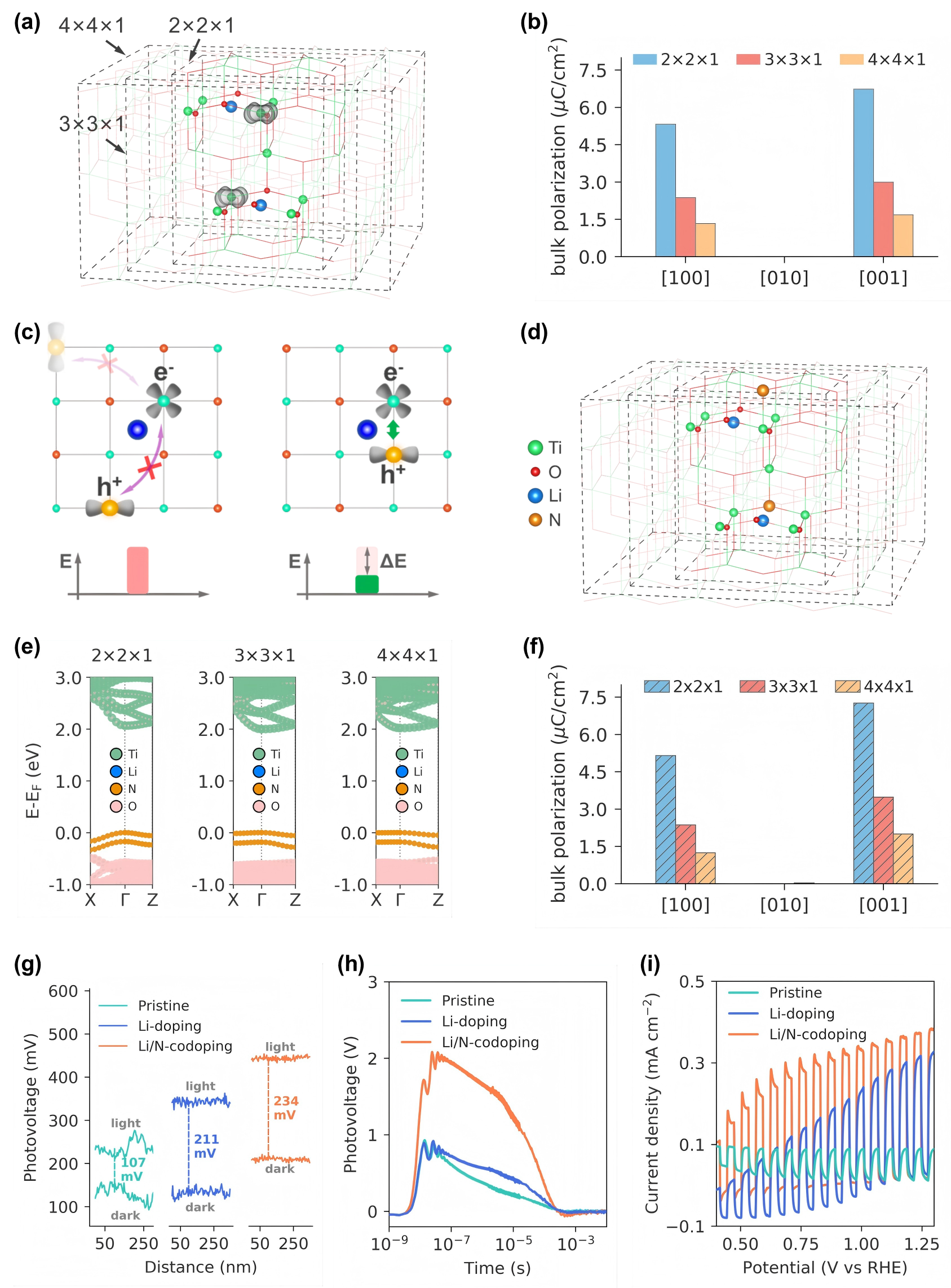
Bulk polarization induced by interstitial Li and charge-compensated N-codoping. (Image by IMR)
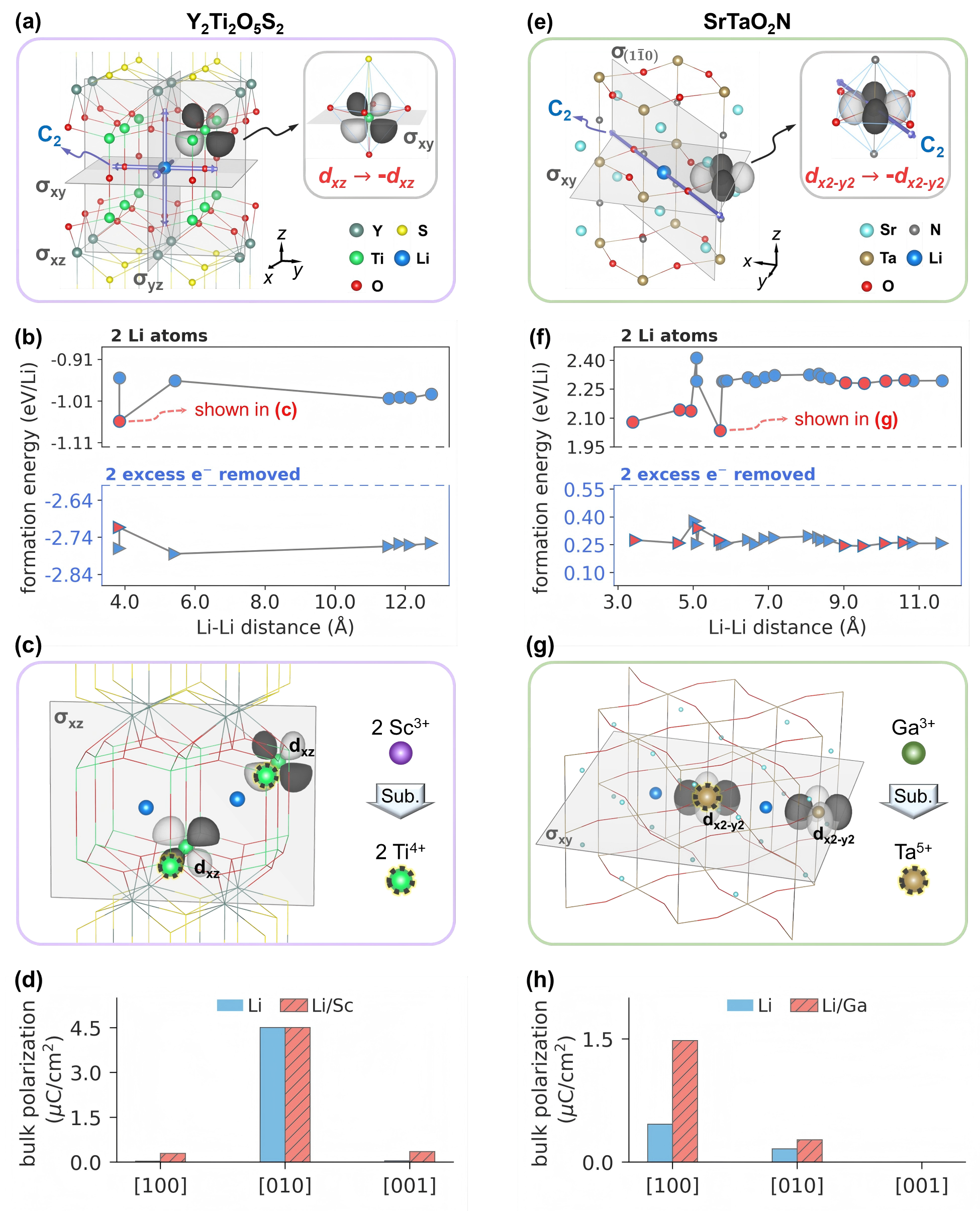
Inducing bulk polarization with interstitial Li and charge-compensated codoping in Y2Ti2O5S2 and SrTaO2N. (Image by IMR)