Scientists from the Institute of Metal Research, Chinese Academy of Sciences (IMR, CAS), have established a new paradigm for designing oxide cathode materials using physicochemical descriptors, moving beyond empirical trial-and-error toward goal-oriented design. The work was recently published in Nature Synthesis.
Oxide cathodes determine the energy density, rate capability, cycle life and safety of lithium-ion batteries. Introducing trace elements has become an important route to tuning crystal structure, ion transport and cycling stability. However, the selection of dopants has long relied on experience and repeated testing, lacking quantitative descriptors that link a dopant’s intrinsic properties to lattice structure and electrochemical performance. This problem is particularly acute for cobalt-free, nickel-rich cathodes, where cobalt removal reduces cost and boosts capacity but exacerbates sluggish lithium-ion transport, local lattice distortion, oxygen framework instability and electrochemical failure.
The IMR team, led by Prof. LI Feng, Prof. CHENG Huiming and Prof. WANG Chunyang, proposed a descriptor-informed multi-component doping strategy. They identified two key parameters—ionic charge density and metal–oxygen bond strength—as descriptors that establish intrinsic correlations between dopant properties, lithium-ion transport and structural stability.
Guided by this framework, the team introduced low-charge-density elements (Mg, Ca) to weaken electrostatic constraints on lithium-ion migration, and strong metal–oxygen bond elements (Ti, Zr) to reinforce the oxygen sublattice and transition-metal–oxygen framework. The resulting cobalt-free, nickel-rich cathode (MD-LNMO) achieved simultaneous improvements in rate performance and structural stability: a specific capacity of 130.9 mAh g⁻¹ at 25 C, 82.4% capacity retention after 350 cycles at 10 C, and 112 mAh g⁻¹ at −20 °C under 1 C. A 5.74 Ah pouch cell delivered an energy density of 278.6 Wh kg⁻¹ at −20 °C.
Multimodal characterization confirmed that the descriptor-driven design simultaneously enhances lithium-ion transport kinetics, suppresses detrimental phase transformations and mitigates electrochemical failure. The work provides a new methodology for developing high-energy-density, long-life and fast-charging cathode materials.
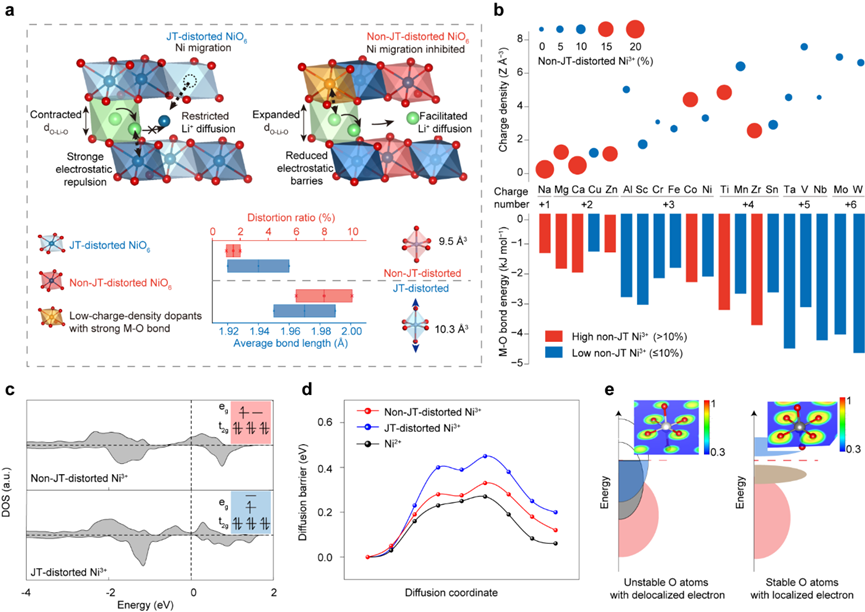
Physicochemical-descriptor-informed design of multi-component-doped cobalt-free nickel-rich cathode material. (Image by IMR)
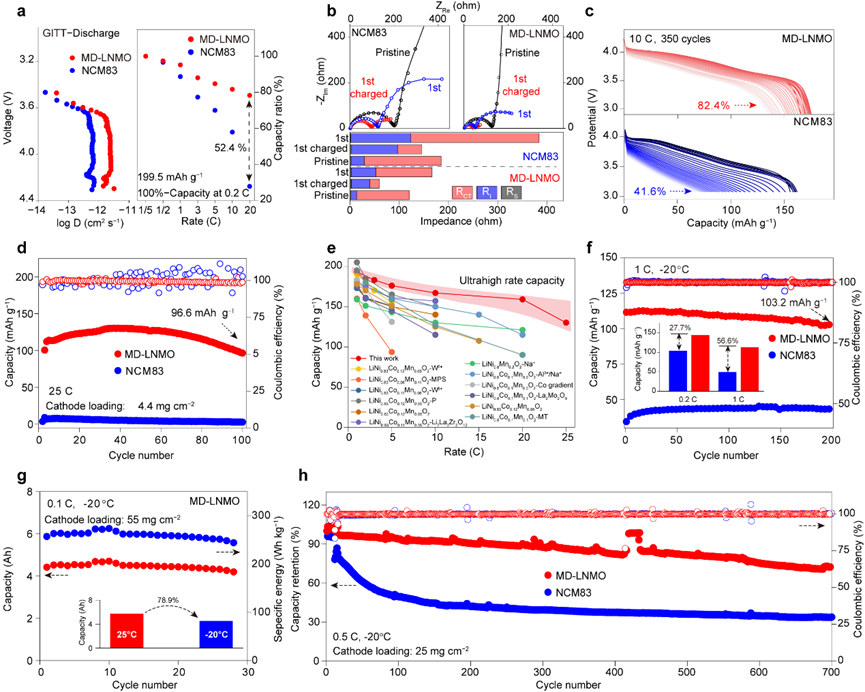
Comprehensive evaluation of the descriptor-informed multi-component-doped cobalt-free nickel-rich cathode material. (Image by IMR)
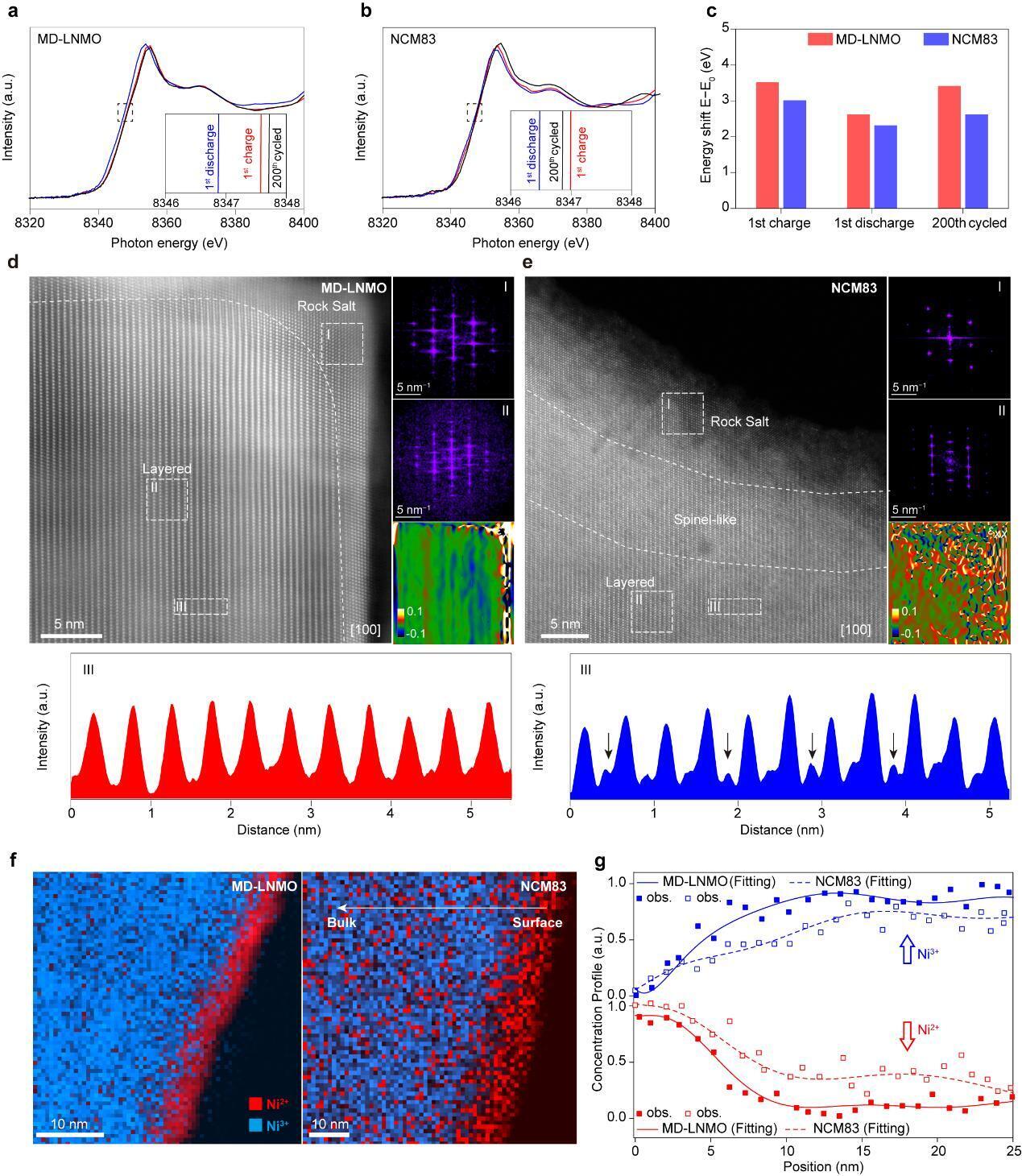
Structural/chemical characterization of the multi-component-doped cobalt-free nickel-rich cathode and commercial cathode after long-term cycling. (Image by IMR)