Scientists from the Institute of Metal Research, Chinese Academy of Sciences (IMR, CAS) have directly observed liquid-like, glass-like and crystal-like phonon behaviors coexisting in a crystalline solid—the layered superionic conductor AgCrSe₂—challenging the conventional boundaries among the dynamical behaviors of crystals, glasses, and liquids and providing new experimental evidence for a unified theory of heat transport.
Phonons are collective atomic vibrations that govern many fundamental properties of materials, including thermal conductivity. In the conventional picture, perfect crystals exhibit well-defined phonon quasiparticles owing to the long-range periodic order of their atomic lattices, whereas phonons in glasses and liquids are strongly damped and transverse modes may even be suppressed because of structural disorder.
AgCrSe₂ is a typical layered superionic conductor with a quasi-two-dimensional structure and a superionic transition near 475 K. Rigid edge-sharing [CrSe₆] octahedra form a stable periodic framework, while Ag⁺ ions occupy two equivalent interlayer sites. Below the transition, Ag⁺ ions preferentially occupy one site; above it, the [CrSe₆] framework remains long-range ordered, but Ag⁺ ions hop randomly between the two equivalent sites, creating a nested structure of a rigid lattice framework and a fluid-like disordered sublattice.
Using high-resolution inelastic neutron scattering, first-principles calculations and molecular dynamics simulations, the team obtained the complete phonon dispersion of AgCrSe₂ single crystals and found a pronounced directional dependence in transverse phonon behavior. For transverse phonons propagating in-plane with in-plane atomic vibrations, the phonon dispersion exhibits a nesting feature that enhances phonon scattering. This enhanced scattering, together with the dynamic disorder of Ag+ ions, suppresses the quasiparticle character of these phonons, resulting in liquid-like behavior. For transverse phonons propagating out-of-plane with in-plane atomic vibrations, scattering caused by the dynamic disorder of Ag+ ions is selective. These phonons gradually lose their quasiparticle character as the wavevector increases, exhibiting glass-like behavior. In contrast, transverse phonons propagating in-plane with out-of-plane atomic vibrations remain well-defined propagating modes even in the superionic state, displaying conventional crystal-like behavior. Thermal conductivity measurements on single crystals reveal ultralow thermal conductivity and pronounced anisotropy in heat transport, consistent with the observed microscopic phonon dynamics. This work, published in J. Am. Chem. Soc., challenges conventional distinctions among states of matter at the level of lattice dynamics and offers new insights into controlling anisotropic phonon transport in solids.
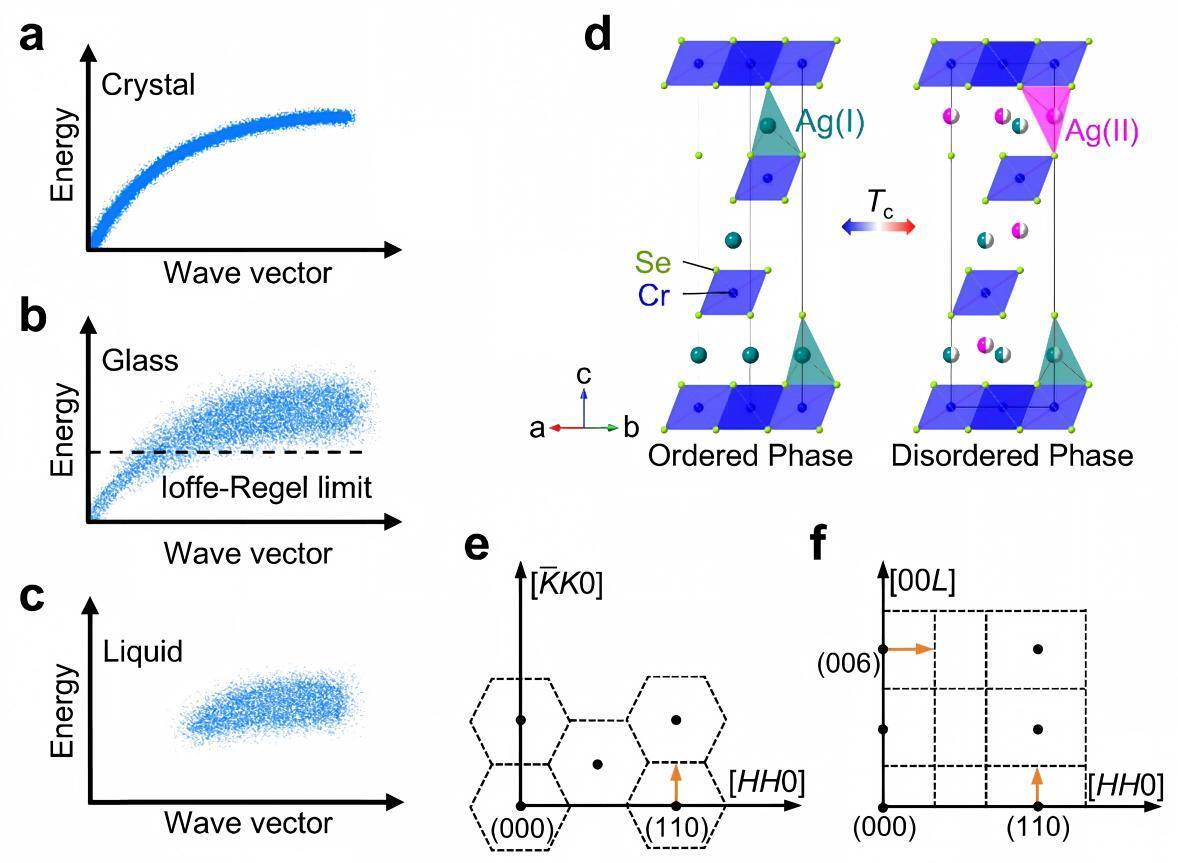
Crystal structure of AgCrSe2 and schematic illustrations of the characteristic transverse-phonon behavior in crystals, glasses, and liquids. (Image by IMR)
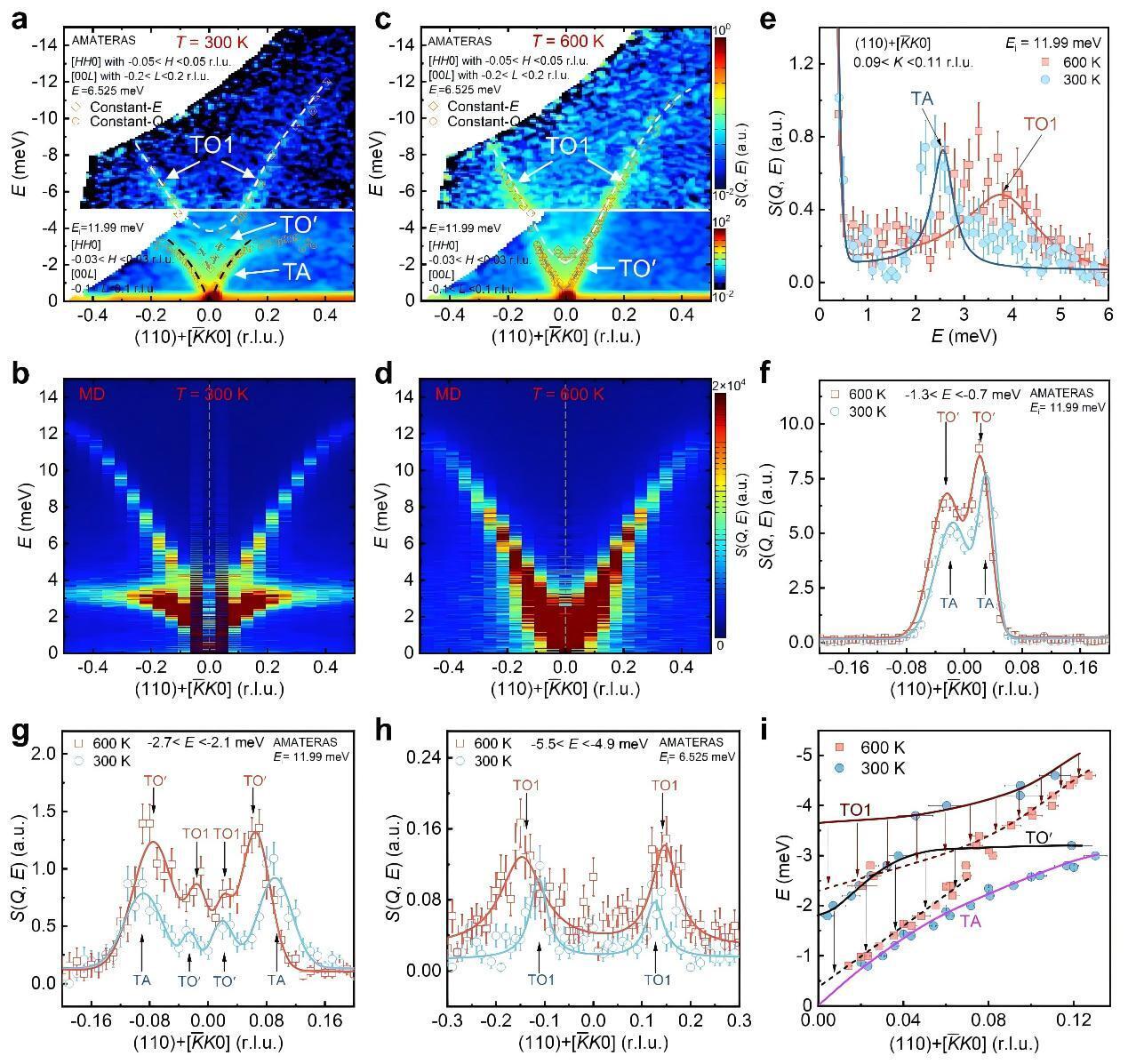
Inelastic neutron scattering experimental results and molecular dynamics simulations of liquid-like transverse phonons. (Image by IMR)